
Cloud Migration


Cloud migration is a strategic management solution that offers businesses flexibility, security and stable operations, regardless of their offices’ and employees’ physical locations. 


Cloud services enable companies to store and process large volumes of data without having to maintain their own server infrastructure, quickly scale IT resources and optimise operating costs. 

Transitioning to a cloud system offers a secure conduit for accessing corporate information from anywhere in the world, ensuring uninterrupted business operations and augmenting the collective cyber resilience of the company. 

At BDO in Ukraine, we support businesses at every stage of their cloud migration journey: from the initial assessment to the implementation of solutions and staff training. We don’t just help with data transfer, we also create a reliable digital foundation for companies to develop sustainably. 

As part of our service, we help businesses to: 

  • transfer server capacity and corporate data to a secure cloud environment 
  • organise effective remote or hybrid working for employees 
  • reduce dependence on local IT infrastructure 
  • enhance cybersecurity and data protection. 


Our approach to cloud migration 

Conducting an initial analysis of the company’s IT infrastructure, assessing its readiness for cloud migration, identifying risks and formulating practical recommendations for the optimal migration model and further digital transformation. 

Transferring servers and data to the Microsoft Azure cloud environment or to a Western hosting in compliance with security requirements and organisation of secure employee access via VPN. 

Implementing tools for collaboration, communication and cloud data storage based on Microsoft 365, including Office 365, Exchange Online, Teams, OneDrive and SharePoint. 

Training company employees to work with cloud services with a focus on the effective use of tools and the secure handling of corporate information. 

Providing consultations on the current level of cybersecurity and identifying areas for strengthening data protection in the cloud environment. 


When should businesses consider migrating to the cloud? 

Businesses should consider moving to the cloud if operational stability and data access are critical to their daily operations and management decision-making. 

Cloud solutions become particularly relevant when a company: 

  • faces power outages or unstable local infrastructure 
  • needs continuous access to corporate systems and data regardless of the office location
  • is transitioning to a remote or hybrid working
  • seeks to minimise the risk of business downtime due to technical or infrastructure factors 
  • plans to scale up without investing in its own servers. 


Migrating to the cloud ensures business continuity, even during power outages, because data and critical systems are stored in secure data centres outside the company’s local infrastructure. 
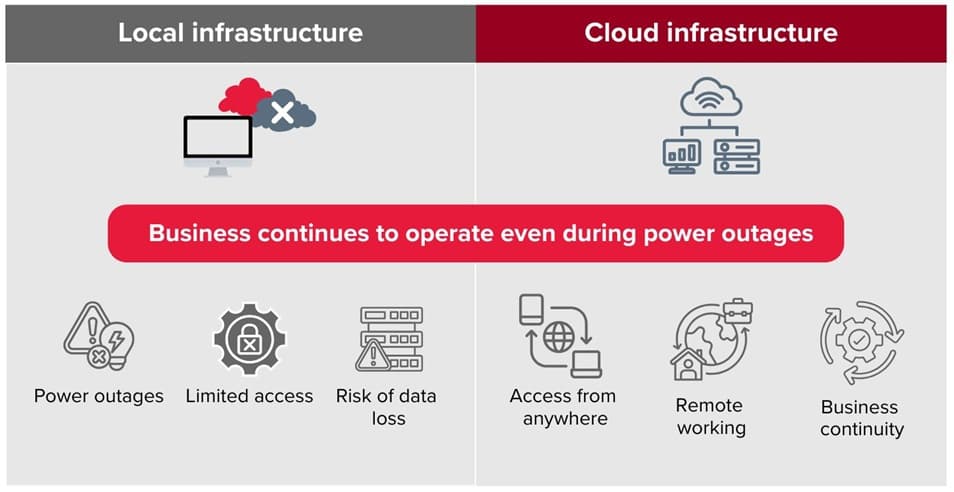
Infographic comparing local and cloud IT infrastructure, demonstrating the advantages of cloud solutions for ensuring uninterrupted business operations during power outages, including remote access from anywhere, reduced risk of data loss, increased system availability, and resilience of critical business processes compared to local infrastructure.


Cloud infrastructure allows companies to maintain data access and maintain their business operations even during power outages and other infrastructure risks.


Key Contacts

Andrii Borenkov

Andrii Borenkov, CFA

Partner, Head of Advisory
View bio

FAQ (Frequently Asked Questions)

Cloud Services — IT resources delivered via the internet for data storage, information processing, application deployment and support of business processes without the use of local servers.

Cloud Migration — the process of transferring data, applications and IT infrastructure from local environments or data centres to cloud platforms.

Microsoft Azure — a corporate cloud platform for hosting servers, databases, applications and services, with high standards of cybersecurity and regulatory compliance.

Microsoft 365 — a suite of cloud-based tools for communication, collaboration and information management, including Office 365, Teams, OneDrive, SharePoint and Exchange Online.

VPN (Virtual Private Network) — a technology that creates a secure, encrypted channel for safe access to corporate resources through public networks.

Remote Work — a work arrangement in which employees gain secure access to corporate systems and data regardless of their physical location.

Digital Transformation — a strategic process of implementing digital technologies and cloud solutions to enhance business efficiency, cyber resilience and competitiveness.

Cybersecurity— a set of technologies, processes and practices aimed at protecting systems, networks and data from cyberattacks, information leaks and unauthorised access.

Hybrid Cloud — an IT infrastructure model that combines local resources with public cloud services for flexible data and workload management.