

As digital business transformation develops, the IT environment is becoming a key factor in operational stability and continuity. The reliability of IT processes now affects not only business efficiency, but also a company’s ability to meet regulatory requirements, protect data, and manage risks.
In this context, the role of the internal audit function is evolving from traditional control to a comprehensive assessment of the technological environment. However, establishing an in-house IT audit team can be a lengthy and resource-intensive process. This is why an increasing number of companies are choosing IT audit outstaffing as a practical way to quickly access the necessary expertise.
This material is based on BDO in Ukraine practical experience of implementing an IT audit outstaffing model for financial institutions.
What is IT audit outstaffing
IT audit outstaffing is a collaboration model in which external experts integrate into a company’s internal audit function, working as part of the client’s team. This approach enables an organisation to enhance its expertise without increasing its workforce.In practice, the IT auditor participates in audit planning, interacts with business units, analyses IT risks, and helps to formulate recommendations for management. Rather than simply receiving external advice, the company gains a full participant in the audit process who works within internal procedures and standards.
This is particularly important for companies in the financial sector and those with increased compliance requirements, where IT risks can directly impact operational stability and reputation.
We provided a major Ukrainian bank with domestic capital as part of one of our projects. This capital was used to strengthen the bank's internal audit in the areas of IT and information security. Our expert was integrated into the internal audit department as a full team member, carrying out audit tasks, liaising with business units, and providing an independent assessment of IT risks.
This collaborative approach enabled the bank to:
- scale expertise flexibly,
- improve the maturity of IT controls and compliance with regulatory requirements without increasing staff numbers.
IT audit outstaffing models
1. Support for internal audit operationsMany organisations have an internal audit department that covers a wide range of business processes, but the IT component often requires separate expertise. This is where outstaffing can be an effective solution.
An IT auditor assists with internal audits and helps to evaluate the technological aspect of business processes.As a result, the audits become more comprehensive and the recommendations are more practical and focused on real risks.
Specialists can participate in:
- assessing the effectiveness of IT resource utilisation
- identifying and assessing IT risks
- analysing information security risks
- developing recommendations for improving IT controls.
2. Conducting specialised IT and information security audits
In addition to supporting operational audits, outstaffing enables highly specialised audits to be conducted that require in-depth technical expertise.
Such audits help companies not only to comply with regulatory requirements (in particular NBU Resolutions No. 95, No. 58, No. 116 and No. 178), but also to proactively identify risks that could affect business continuity.
Typical areas include:
- audit of information security management system (ISMS)
- audit of compliance with NBU requirements
- audit of IT change management
- assessment of server and network architecture
- audit of IT processes (access, incidents, business continuity).
Such audits provide a comprehensive overview of the state of the IT environment, enabling the development of a practical plan to improve its maturity.
Benefits of IT audit outstaffing for businesses
IT audit outstaffing provides companies with real added value by combining access to expertise with effective resource management.Engaging external IT auditors ensures:
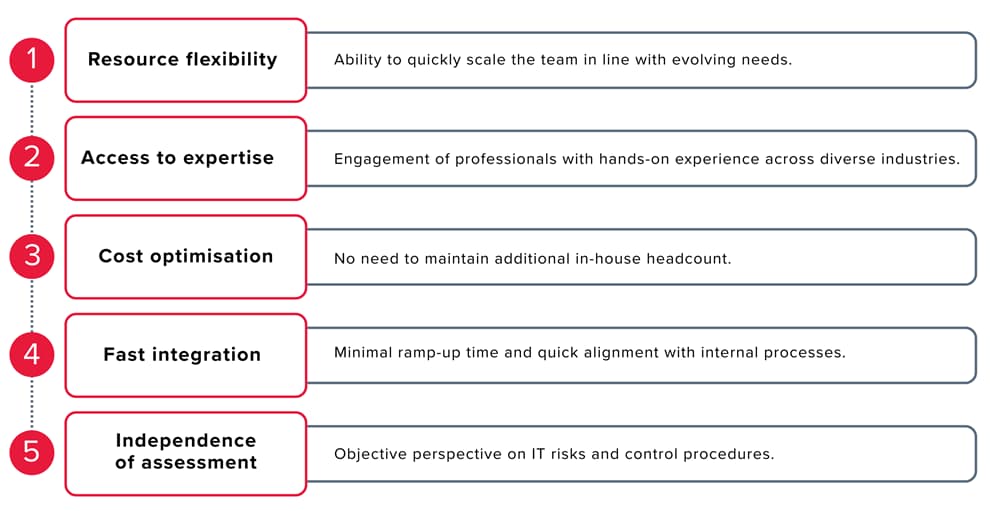
These factors together make outstaffing one of the most effective ways of developing the internal audit function.
When IT audit outstaffing makes the most sense
Practice shows that this model offers the greatest value to companies in a phase of active development or transformation.Outstaffing is particularly appropriate if:
- the company does not have its own IT auditor
- the existing internal audit team needs to be strengthened
- there is a need to conduct complex or specialised audits
- regulatory requirements and compliance expectations are increasing.
In such circumstances, outstaffing enables you to meet your expertise needs quickly without making long-term changes to the company’s structure.
In summary, IT audit outstaffing is a modern tool for developing internal audit that combines flexibility, expertise and cost-effectiveness. Integrating external specialists into internal processes enables companies to enhance the maturity of IT controls, strengthen information security, and meet regulatory requirements with confidence.
As a result, businesses gain compliance and added value through improved risk management efficiency and transparent IT processes.
Contact BDO in Ukraine if you need to quickly strengthen your internal IT audit without expanding your team. We integrate our experts into your processes and help you to improve the maturity of IT controls, risk management and compliance.