AI, Trust, and Professional Judgment: BDO in Ukraine at IFRS Forum Ukraine 2026
AI, Trust, and Professional Judgment: BDO in Ukraine at IFRS Forum Ukraine 2026
BDO in Ukraine participated in IFRS Forum Ukraine 2026, dedicated to Accountant and Auditor Day. This year’s forum, held under the theme “The Key Role of the Profession in Building Sustainable Ecosystems,” brought together representatives of the professional community, businesses, public institutions, and technology companies to discuss the transformation of accounting and auditing.
Key topics discussed on the first day included digitalisation, the use of artificial intelligence, professional judgement, and trust in an era of rapid technological advancement. One of the key highlights of the programme was the Digital Drive session, “The Future of the Profession: AI, Trust and Professional Judgement.” The session was moderated by Alla Savchenko, President of BDO in Ukraine and Chair of the Supervisory Board of the Federation of Professional Accountants and Auditors of Ukraine.
Participants in the session discussed key trends shaping the digital transformation of accounting and auditing, including the potential of artificial intelligence in financial reporting, process automation, the adoption of GPT- and RPA-based solutions, and the legal and ethical implications of emerging technologies. Attention was also given to replacing russian software with Ukrainian and international alternatives, the current state of the market, and the legislative and regulatory changes required to support this transition.
Opening the session, Alla Savchenko emphasised that Ukrainian accountants and auditors continue to carry out their professional responsibilities amid the challenges of the full-scale war. Among members of the profession are individuals serving on the front line, as well as accounting professionals working in the defence and humanitarian sectors, ensuring transparency in the use of funds and supporting the mobilisation of international assistance.
Alla Savchenko highlighted the transformation of the profession driven by artificial intelligence. According to Ms Savchenko, the accounting and audit profession has already undergone major technological shifts, including the introduction of personal computers, specialised software, Excel, and data analytics tools. However, the changes taking place today are far more profound, requiring professionals to embrace new technologies while remaining mindful of the risks they may bring.
“The accounting profession is undergoing the most significant transformation in its history. Artificial intelligence presents tremendous opportunities, but every new opportunity comes with risks. Professionals who do not use modern tools, or use them only occasionally, are already missing out on the benefits they could otherwise realise. That is why we must not postpone this transformation. Instead, we need to explore practical solutions, understand their limitations, and integrate them into our professional activities responsibly”.
Alla Savchenko also highlighted the need to complete the transition away from russian software. She emphasised that migrating to alternative solutions can be complex and may require additional resources; however, in the context of the ongoing war, this is no longer solely a technological issue but also a matter of security.
As part of the thematic session, speakers shared practical perspectives on the transformation of the finance function driven by artificial intelligence. Discussions covered the evolving roles of finance professionals, the automation of accounting processes and document management, the shift in auditing from sample-based testing to the analysis of entire data sets, as well as the risks associated with AI adoption and the need to establish effective AI governance frameworks. Emphasis was placed on the fact that while technology enhances productivity and improves the quality of analysis, professional judgement, oversight, and accountability remain firmly in human hands.
Key insights from the speakers:
- AI is not replacing finance professionals; it is transforming their roles. Digital literacy, business acumen, critical thinking, ethical judgement, communication skills, and the ability to oversee AI systems are becoming increasingly important. With more than 696,000 members and students across 192 countries, AICPA & CIMA is uniquely positioned to monitor and identify global trends shaping the future of the profession.
- IT-Enterprise processes around 225,000 AI requests and 977 million tokens monthly across its systems and currently manages a portfolio of 20 active AI projects. In one practical case study, over 26,000 documents were processed automatically within three months.
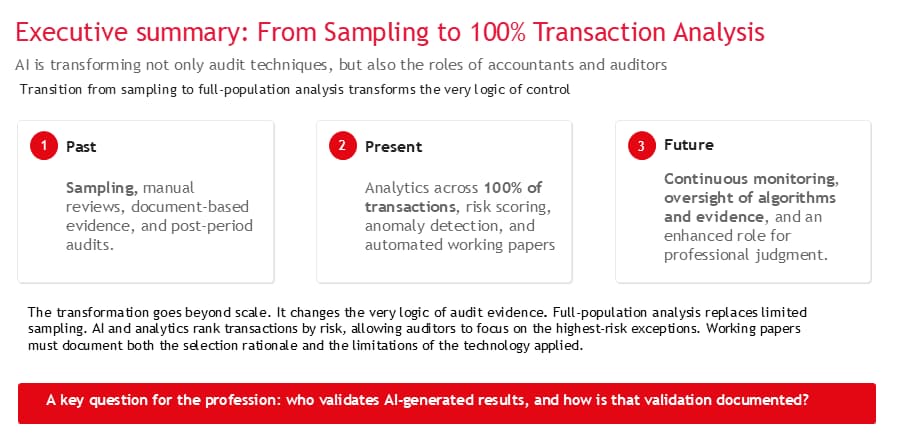
- AI enables a shift from sample-based testing to 100% transaction analysis, automated risk scoring, and the identification of anomalies in journal entries, payments, contracts, and source documents. At the same time, auditors remain responsible for assessing data quality, validating algorithmic logic, and documenting their professional judgement.
- Among the key risks associated with AI adoption are the leakage of confidential data, the uncontrolled use of third-party services, the compromise of access credentials, and vendor dependency.
- To support the safe adoption of AI, businesses are advised to establish an AI solutions register, classify data, implement access controls, logging and monitoring mechanisms, conduct vendor due diligence, and regularly test security safeguards. A practical roadmap for building such a framework can be implemented within the first 90 days, drawing on the principles of ISO 42001, ISO 27001, and the EU AI Act.
Participation by Andrii Borenkov, Head of Advisory at BDO in Ukraine, in the panel discussion further reflected the firm’s ongoing commitment to digital transformation. Together with representatives of technology companies and professional organisations, he contributed to discussions on the practical application of AI, the automation of accounting and reporting processes, and the role of AI in auditing.
Mr Borenkov explained how AI and data analytics are reshaping the very nature of auditing, enabling a shift from testing limited samples to analysing entire populations of transactions, performing risk scoring, and identifying unusual transactions. In this context, the auditor’s role is not diminishing but evolving: less time is spent on routine procedures, while greater responsibility is placed on assessing data quality, evaluating the reliability of algorithms, interpreting exceptions, and documenting professional judgement.
Andrii also shared BDO in Ukraine’s practical experience in using enterprise solutions based on Microsoft 365 Copilot, prompt libraries, Power BI, and the BDO Portal. He emphasised that AI should be deployed within a secure environment and integrated into the firm’s quality management system, rather than used as an informal personal tool.
“Artificial intelligence does not eliminate the need for auditing; it changes the very focus of professional judgement. When it becomes possible to test not just a hundred transactions but an entire population, what matters most is no longer the scope of testing but the ability to interpret exceptions correctly, assess risk, and explain the conclusions reached. AI may identify an exception, but it cannot assume audit responsibility”.
BDO in Ukraine has been a regular participant in IFRS Forum Ukraine for several years. Traditionally held in conjunction with Accountant and Auditor Day, the event brings together professionals to discuss key developments shaping the industry. Representatives of BDO in Ukraine contribute to panel discussions focused on digitalisation, business process automation, artificial intelligence, and the future of the profession.
We will continue to support professional dialogue and share practical experience in implementing technologies that help businesses improve efficiency, transparency, and resilience. To learn more about BDO in Ukraine’s capabilities in digital transformation, process automation, data analytics, and AI-powered solutions, we invite you to contact our experts.