Ukraine’s Reconstruction and the Role of Border Regions: Key Takeaways from the FIEC EIC Task Force
Ukraine’s Reconstruction and the Role of Border Regions: Key Takeaways from the FIEC EIC Task Force
During the FIEC–EIC Task Force “Ukraine” meeting, representatives of the European construction sector and Ukrainian industry associations discussed approaches to Ukraine’s future reconstruction and the strategic role of its border regions.
The event became a platform for sharing practical ideas on attracting investment, supporting businesses, and advancing Ukraine’s integration into the EU economic space.
Among the participants were members of the Confederation of Builders of Ukraine (CBU) together with representatives of European institutions and businesses. The event outlined the key challenges and opportunities for developing infrastructure, logistics, and small and medium sized enterprises in the context of Ukraine’s post war recovery.
During the FIEC EIC Task Force “Ukraine” discussions, particular attention was given to Ukraine’s border regions — Volyn, Zakarpattia, Lviv, and Chernivtsi — identified as potential pilot areas for launching new business models and deepening economic integration with the European Union.
The presentation highlighted that Ukraine’s border regions play a strategic role in reshaping trade and logistics flows toward the EU. These regions have already become key growth hubs for small and medium sized enterprises seeking new opportunities for exports, production localization, and the delivery of goods and services to European markets.
Practical recommendations for supporting businesses and developing Ukraine’s border regions are also presented in the EBA White Paper developed in cooperation with BDO in Ukraine, Supporting Business in the Regions of Ukraine that Border the EU. The document summarizes key challenges, instruments of state and international support, and opportunities for entrepreneurs in the context of Ukraine’s reconstruction and EU integration.
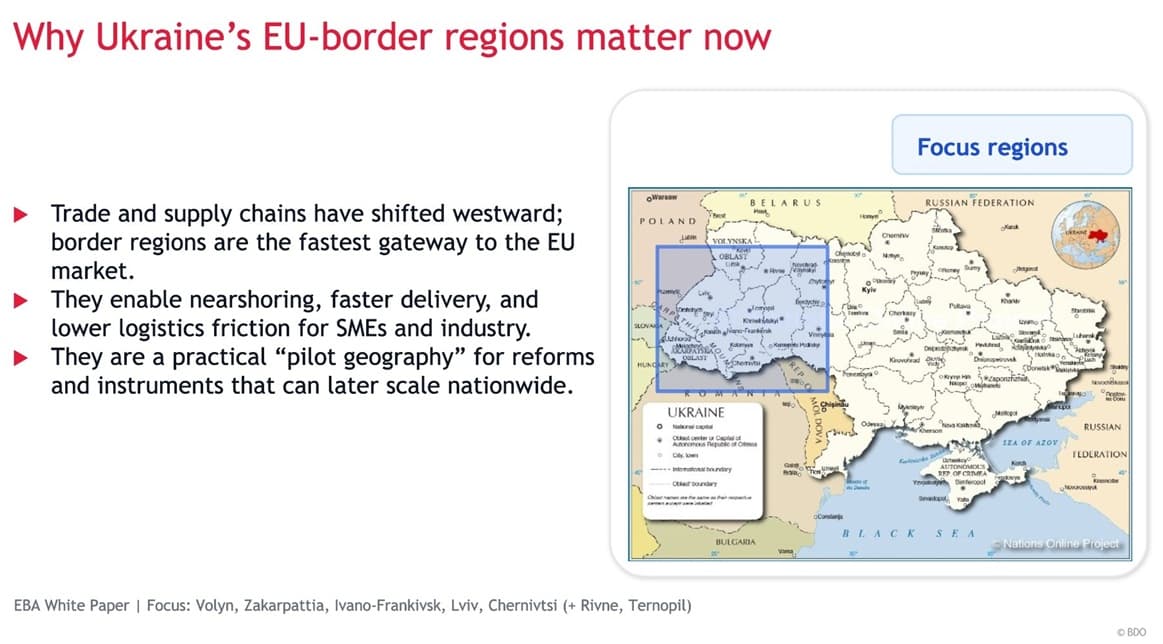
“Ukraine’s reconstruction is not just about rebuilding infrastructure — it is about creating new growth opportunities for businesses through innovation and strategic partnerships. Border regions should become pilot platforms for transformative reforms that can later be scaled nationwide, helping attract investment and accelerate economic development,” noted Vira Savchenko, CEO of BDO in Ukraine.
Additional emphasis was placed on the need for strong government support — from developing industrial parks and unified logistics corridors to simplifying customs procedures and adopting European certification standards. Vira Savchenko also called for expanded financing and dedicated credit programs for small and medium sized enterprises, which have the potential to become a key engine of Ukraine’s economic recovery.
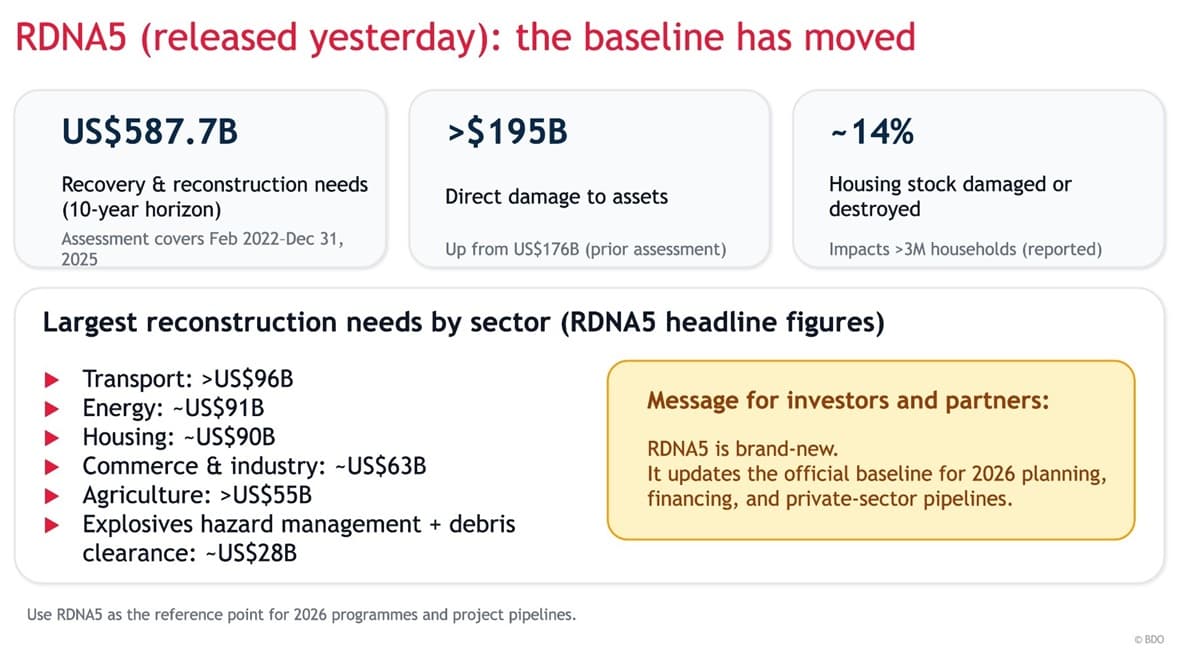
The presentation also spotlighted the new RDNA5 assessment outlining Ukraine’s recovery and reconstruction needs, highlighting the most significant priorities across key sectors such as transport, energy, housing, and agroindustry. Vira emphasized that these insights should guide the Government of Ukraine and the business community in defining strategic funding priorities for the country’s recovery in the years ahead.
During the session, key industry leaders outlined the most pressing challenges and emerging opportunities for Ukraine. Lev Partskhaladze, President of the CBU, summarized the impact of four years of full scale war on the construction sector. Ihor Taranov from the Horizon Europe office provided an in depth overview of available calls and funding opportunities for businesses and research initiatives. The session concluded with a presentation by Ihor Platonov, who showcased practical reconstruction cases — from the comprehensive rebuilding of the village of Yahidne to the implementation of individual infrastructure projects.
This event marked a significant step toward driving practical reforms to strengthen Ukraine’s business environment and position its border regions as powerful platforms for national recovery. The discussion brought together business leaders and government representatives, creating a collaborative space focused on accelerating and enhancing the effectiveness of Ukraine’s reconstruction efforts.
Discover how businesses can engage in Ukraine’s recovery, contribute to the development of border regions, and build partnerships with European stakeholders — and explore BDO in Ukraine’s latest insights and expertise.
If you have questions or would like to discuss potential cooperation, our experts are ready to help — simply submit your request through the contact form.