
Vira Savchenko
CEO
Ukraine’s recovery is not only about rebuilding what has been damaged. It is about creating a stronger, more resilient and more competitive economy.
Digital infrastructure, ICT/TMT services, GovTech, cybersecurity, AI, data infrastructure and dual-use innovation are central to this process. They support business continuity, public-sector efficiency, investor confidence and long-term growth.
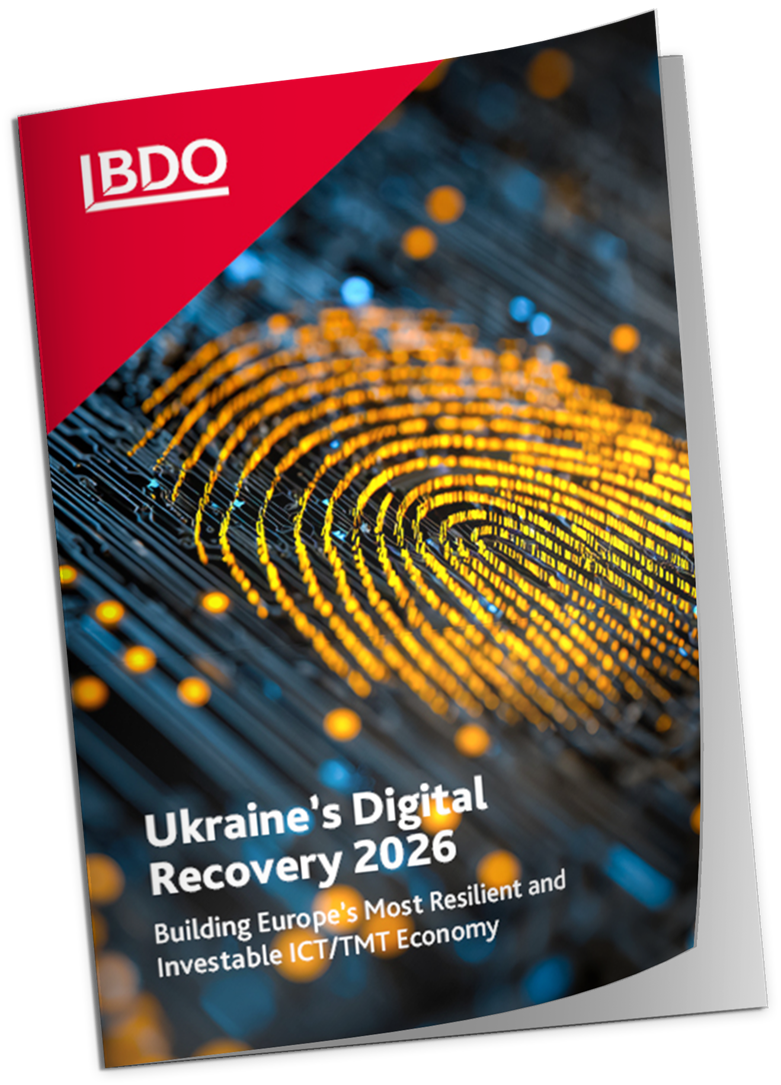
Ahead of Ukraine Recovery Conference 2026, BDO in Ukraine has prepared Ukraine’s Digital Recovery 2026 — a policy and investment-focused white paper on Ukraine’s ICT/TMT sector, its investment potential, project pipeline, key risks and partnership models.
Why this matters for URC 2026
Ukraine’s digital sector should be treated as a recovery multiplier, not as a secondary reform track.
Digital systems help businesses, public services, hospitals, municipalities, logistics chains and critical infrastructure continue operating under disruption. At the same time, they create opportunities for productivity growth, exports, innovation and international partnerships.
For URC 2026, the key task is to move from broad interest in Ukraine’s digital resilience to structured, bankable and investable projects.
Ukraine’s ICT/TMT investment thesis
Ukraine’s digital economy is already operating at meaningful scale.
Key signals include:
These indicators show that Ukraine’s digital sector is not only resilient. It is commercially active, internationally connected and investable now.
Five investable verticals
The white paper identifies five ICT/TMT verticals where public demand, commercial logic, resilience needs and strategic relevance intersect:
These areas are relevant for investors, technology companies, IFIs, DFIs, strategic partners, project sponsors and public-sector stakeholders working with Ukraine’s recovery and long-term competitiveness.
From interest to execution
The central investment question is not whether Ukraine has digital demand or implementation capacity. The key question is how capital should be structured and how projects can be prepared for investor scrutiny.
For many ICT/TMT projects, credible preparation requires:
This is where sector visibility must turn into transaction execution.
How BDO in Ukraine supports ICT/TMT investors, companies and project sponsors
BDO in Ukraine supports clients across the ICT/TMT investment lifecycle — from sector analysis to transaction execution and post-investment assurance.
For international investors and strategic partners, we support market entry analysis, partner and project screening, financial, tax and legal due diligence, valuation, transaction advisory, deal structuring and post-investment reporting.
For Ukrainian ICT/TMT companies and project sponsors, we support investment readiness, financial modelling, business plans, investment memoranda, investor presentations, data-room preparation, vendor assistance, governance, Diia.City-related support, audit, tax and legal compliance.
For public-sector and institutional stakeholders, we support project preparation, bankability analysis, de-risking logic, blended-finance structuring, funding models and implementation frameworks.
Our role is to help move ICT/TMT opportunities from sector narrative to investor-ready projects, structured transactions and practical implementation.
Why BDO
BDO in Ukraine combines local market knowledge with the capabilities of the international BDO network.
Our teams work across audit, tax, legal, advisory, M&A, valuation, business services, digital transformation and investment support. This allows us to assess ICT/TMT projects from financial, regulatory, operational, investment and execution perspectives.
For companies and investors working with Ukraine’s digital sector, this integrated approach is critical.
Ukraine’s Digital Recovery 2026 provides a structured overview of Ukraine’s ICT/TMT investment potential ahead of URC 2026.
The white paper covers:
BDO’s role in supporting ICT/TMT investment and transaction execution
Let’s discuss your ICT/TMT investment, partnership or scaling project
Whether you are an investor assessing Ukraine’s ICT/TMT sector, a technology company exploring market entry, a Ukrainian business preparing for financing, or a project sponsor developing an investment case, BDO in Ukraine can support your next step.