Annex D. Regulatory Frameworks, Security and Compliance
D9. Political and war risks mitigation possibilities


D9. Political and war risks mitigation possibilities
Political risks are associated with government actions which deny or restrict the right of an investor/owner i) to use or benefit from his/her assets; or ii) which reduce the value of the firm. Political risks include war, revolutions, government seizure of property and actions to restrict the movement of profits or other revenues from within a country.
By purchasing political risk insurance (PRI), investors can successfully strengthen their position in the host state, allocating the burden of political risk to third parties (insurance agencies). PRI is provided by international organizations, such as the Multilateral Investment Guarantee Agency (MIGA) and state-sponsored insurance agencies, known as export credit agencies (ECAs) or public insurance agencies.
Political risks covered PRI providers cover very similar sets of political risks:
Most credit agencies have frozen their limits for Ukraine because of the lack of instruments in place.
War risk - risks associated with war, such as physical damage to goods and assets, hostile occupation, and contract obligation breaches for war-related reasons, including bank loans, goods, or services supply. It should cover not only total losses of property but also damages of a moderate scale.
1. MIGA - Multilateral Investment Guarantee Agency
MIGA is a member of the World Bank Group. MIGA’s mandate is to promote cross-border investment in developing countries by providing guarantees (political risk insurance and credit enhancement) to investors and lenders.
MIGA provides political risk insurance guarantees and credit enhancement to private sector investors and lenders. MIGA’s guarantees protect investments against non-commercial risks and can help investors obtain access financing on improved terms and conditions.
MIGA’s War and Civil Disturbance coverage provides protection against loss from, damage to, or the destruction or disappearance of, tangible assets or total business interruption (the total inability to conduct operations essential to a project’s overall financial viability) caused by politically motivated acts of war or civil disturbance in the country, including revolution, insurrection, coups d’état, sabotage, and terrorism.
For tangible asset losses, MIGA pays the investor’s share of the lesser of the replacement cost and the cost of repair of the damaged or lost assets, or the book value of such assets if they are neither
being replaced nor repaired. For total business interruption that results from a covered war and
civil disturbance event, compensation is based, in the case of equity investments, on the net book value of the insured investment or, in the case of loans, the insured portion of the principal and interest payment in default. This coverage encompasses not only violence in the host country directed against a host country government, but also against foreign governments or foreign investments, including the investor’s government or nationality.
Temporary business interruption may also be included upon a request from the investor and would cover a temporary but complete cessation of operations due to loss of assets or unreasonably hazardous conditions in the host country, which result in a temporary abandonment or denial of use. For short-term business interruption, MIGA pays unavoidable continuing expenses and extraordinary expenses associated with the restart of operations and lost business income or, in the case of loans, missed payments.
MIGA covers capital and debt insurance up to 90%.
Cost of insurance for Ukraine is believed to be up to 1%
MIGA’s Product Lines available in Ukraine
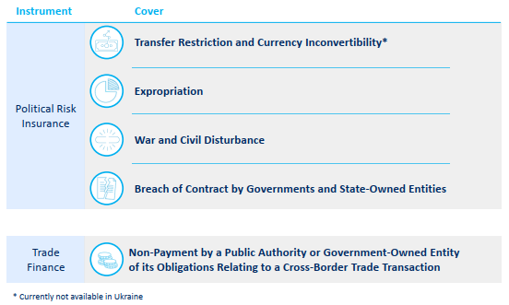
Political Risk Insurance (PRI) solutions for Investors and Lenders

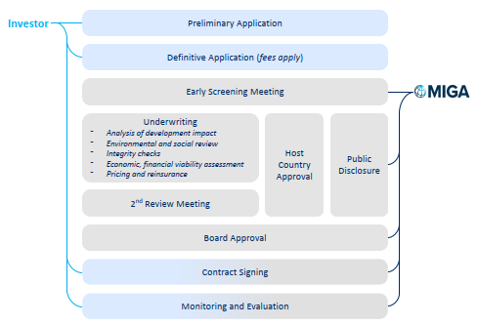
Registration and Underwriting Process
2. List of International Export Credit Agencies and other organisations that announced support to Ukraine
| No | Country | Agencies | Web | Conditions |
| 1 | Austria | OeKB | Link | Primarily available under the Ukraine Facility for public‑sector reconstruction projects, subject to a sovereign or state‑bank guarantee. Support is limited to infrastructure‑related transactions (e.g. transport, energy, municipal services) and provided on a strict case‑by‑case basis. Coverage may reach 100% for political risk and up to 98% for commercial risk (state‑bank obligors). Private‑sector transactions are supported only to a limited extent under standard export guarantee schemes outside the Facility. |
| 2 | Belgium | CREDENDO | Link | Buyer Credit InsuranceThe Belgian government asked Credendo to resume coverage of export transactions on Ukraine, acting for the account of the Belgian State. An amount of EUR 100 million will be made available for this purpose, of which EUR 75 million for short-term transactions (risk duration of maximum one year) and EUR 25 mln for medium- to long-term transactions (risk duration above one year). That ceiling could later be raised based on positive experience. Insurance will be made available for transactions with sufficient Belgian interest and for a maximum of EUR 15 mln per transaction. Moreover, where necessary, guarantees from Ukrainian banks or authorities will be required. |
| 3 | Canada | Export Development Corporation | Link | As international risk experts, EDC helps Canadian companies to navigate, manage and take on risk to support their growth beyond Canada’s borders. EDC`s solutions include:
Practical example: Investor Support Chain (Team Canada Model) (a best‑practice illustration of how an Export Credit Agency functions within a full support ecosystem)
|
| 4 | Czech Republic | Export Guarantee and Insurance Corporation | Link | On 17 April 2024, the Czech government approved a new policy by the Ukraine EGAP Fund, allowing for the insurance of Czech companies' exports to Ukraine up to EUR 5 million without the need to confirm previous relationships between the parties. At a meeting on April 19th with EGAP's management, the possibility of further simplification of conditions was discussed, as Ukraine has so far fulfilled all obligations and no insurance payouts have been necessary. Additionally, the National Development Bank of the Czech Republic will administer part of the EU funds for Ukraine, potentially providing guarantees for international orders. |
| 5 | Denmark | Export and Investment Fund of Denmark | Link | The financing for Ukrainian public entities covers projects within critical infrastructure The financing for Ukrainian private entities covers projects that contribute to development of the private sector and the economy of Ukraine Danish content constitutes a minimum of 30% of the financing amount The borrower’s equity must be at least three times higher than the loan amount. The borrower shall provide audited financial reports covering the last five years. The Danish exporter must fill out and submit “EIFO’s application form for state loan and guarantee scheme in EIFO” |
| 6 | Finland | Finnvera Oyj, Finnish Export Credit Ltd (FEC) | Link | Finnvera with up to EUR 50 mln in compensation for credit losses sustained in connection with export credit guarantees granted for the promotion of exports and investments to Ukraine. Finnvera will resume granting export credit guarantees from 1 January 2024. This arrangement applies particularly to financing options for short-term trade (such as documentary credit guarantees and credit insurance), which are particularly important for securing SME exports. The provision of export credit guarantees for medium and long-term trade can also be gradually increased. |
| 7 | France | Bpifrance | Link | The French state-owned insurance company Bpifrance Assurance Export will insure French companies that are ready to invest in Ukraine and take an active part in the country’s reconstruction without waiting for the war to end. Any company operating under French law and making a long-term investment abroad in a new or existing company, or any credit institution providing a bank loan to a foreign subsidiary, is eligible for this investment insurance. It protects investors or lending institutions against the risks of property damage or non-payment, non-transfer, expropriation or political violence. The insurance covers up to 95% of the loss of the investor’s assets or receivables. |
| 8 | Germany | Export Credit Guarantee(administered by Euler Hermes AG) | Link | Hermes Cover supports German exports to Ukraine by covering commercial risks (buyer insolvency and protracted default with a six‑month waiting period) and political risks, including war‑related events and conversion and transfer restrictions. Short‑term transactions are generally unrestricted, while medium‑ and long‑term transactions are available within a ceiling of EUR 250 mln, typically around EUR 10 mln per transaction, with coverage levels of up to 95%, subject to credit assessment and, where applicable, collateral or state guarantees. |
| 9 | Ireland | Ireland – Ukraine Credit Guarantee Scheme (SBCI) | Link | The Ukraine Credit Guarantee Scheme provides government‑backed loans to support Irish businesses affected by the economic impact of Russia’s invasion of Ukraine. The scheme has a lending ceiling of EUR 1.2 bln and supports working‑capital and medium‑term investment loans of up to EUR 1 mln with maturities of up to 6 years. Loans of up to EUR 250,000 are available without personal guarantees or collateral, while reduced interest rates apply compared to standard market rates (available until 31 December 2024). The scheme targets SMEs, farmers, fishers and small mid‑caps and is delivered through participating lenders with pre‑eligibility via the SBCI Hub. |
| 10 | Italy | SACE (Export Credit Agency) / SIMEST (Gruppo CDP) | Link 1 Link 2 | SACE provides export credit guarantees and investment protection covering political and war‑related risks, including expropriation, war and civil unrest, currency conversion and transfer restrictions. Coverage may extend to invested capital, shareholders’ loans and profit‑related cash flows, with the possibility to transfer insurance rights to financing banks. Following russia’s invasion of Ukraine, SACE resumed operations for Ukraine in April 2023, initially allocating EUR 500 mln and subsequently announcing an additional EUR 1 bln to support trade and financial operations. This support is complemented by SIMEST (Gruppo CDP), which provides financing and equity participation of up to 49% in foreign subsidiaries for a duration of up to 8 years, with SIMEST‑backed investments benefiting from SACE risk coverage. |
| 11 | Japan | NEXI (Nippon Export and Investment Insurance) | Link | NEXI provides insurance coverage for export and investment transactions, covering both commercial risks (such as insolvency or payment default of overseas counterparties) and political risks, including war‑related events, currency transfer and conversion restrictions, and other government‑related actions beyond the control of the parties. In the context of Ukraine, NEXI has remained open for underwriting export and investment insurance since February 2022 and, in February 2024, signed a Memorandum of Understanding with ECA Ukraine, strengthening cooperation in export and investment insurance and reinsurance to support Japanese companies’ trade and investment activities related to Ukraine. Coverage is available, inter alia, through buyers’ credit insurance, supporting Japanese exports and related financing. |
| 12 | Latvia | ALTUM | ALTUM provides export credit guarantees covering buyer’s commercial risks and political risks, including non‑payment. The guarantee also covers the risk of the guarantor of the buyer’s obligations, such as the buyer’s bank or an affiliated company. The guarantee serves as additional security for guarantees or letters of credit issued by the buyer’s bank where there are concerns about the bank’s liquidity, and may be used as collateral in factoring or to secure bank financing for working capital and other current assets. Since 2025, Latvia participates in the EU InvestEU Ukraine Export Credit Guarantee Facility, backed by the European Investment Fund, with EUR 300 mln in total guarantees, including EUR 7.2 mln allocated to Latvia. | |
| 13 | Lithuania | ILTE | Link | ILTE provides export credit guarantees covering buyer’s commercial risks and political risks, including insolvency and non‑payment. Coverage amounts to up to 90% of the deferred payment under the export contract. The maximum guarantee exposure is EUR 2 mln per exporter and EUR 750,000 per individual foreign buyer (with an overall cap of EUR 2 mln per buyer across all exporters). Export transactions are generally supported with deferred payment terms of up to 24 months. Guarantees may be used as additional security for bank guarantees or letters of credit, and as collateral for factoring or working‑capital financing. Pricing depends on country risk and coverage type; for Ukraine (risk group 7), indicative premiums range from ~0.9% (commercial risk) to ~1.5% (commercial and political risk). |
| 14 | Netherlands | Atradius | Link | Atradius Dutch State Business provides export credit insurance covering commercial and political risks, including buyer insolvency, non‑payment, war, government actions and natural disasters. Cover is available for post‑delivery (credit risk) and, where relevant, for pre‑delivery risk related to production or project execution costs. Under the Netherlands’ dedicated Ukraine support package (launched in October 2023 and expanded in 2025), export credit insurance for Ukraine offers coverage of up to 98% of the contract value for both commercial and political risks. The Dutch government has reserved up to EUR 120 mln to insure export transactions to Ukraine. The insured party retains a deductible (own risk) of typically 2–10% of the contract value. Subject to prior approval, insured risks may be transferred to financing banks or other parties involved in the transaction. The scheme applies to both SMEs and large companies, and eligibility was extended to defence‑related transactions in 2025. |
| 15 | Norway | Eksfin | Link | Eksfin provides government‑backed loans, buyer credit guarantees, supplier credit guarantees, performance guarantees and trade reinsurance to support exports of Norwegian goods and services. Coverage addresses commercial and political risks, including buyer insolvency, non‑payment, war and government actions. Depending on the instrument and structure, risk coverage can reach up to 90–100%, with part of the risk typically retained by the exporter or financing bank. Tenors may extend up to 15 years, depending on the nature and economic life of the exported goods or projects. Since 2025, Eksfin operates a dedicated Ukraine arrangement with a guarantee framework of NOK 630 mln, allowing higher risk appetite for Ukraine‑related transactions. There is no standardised per‑transaction cap, with financing decided case‑by‑case based on credit assessment and project structure. Priority sectors include energy, infrastructure, construction, maritime and industrial projects. |
| 16 | Poland | KUKE | Link | KUKE, the Polish official export credit agency, provides export credit insurance and guarantees covering commercial and political risks related to exports and investments. In the context of Ukraine, KUKE launched a special support programme of EUR 53.6 mln to facilitate Polish exports to Ukraine, including reconstruction‑related projects. The support covers non‑payment, war risk, force majeure and government actions, and may be used to secure bank financing for export transactions. The programme is targeted at both SMEs and large companies engaged in trade with Ukraine and is implemented as part of Poland’s broader support for Ukraine’s economic recovery. |
| 17 | Portugal | COSEC | Link | COSEC, acting on behalf of the Portuguese State and operated by Allianz Trade, provides officially supported export credit insurance and guarantees covering commercial and political risks, including war, expropriation, transfer and currency inconvertibility. Coverage is available for short‑term export transactions (up to 2 years) as well as medium‑ and long‑term supplier and buyer credits, with tenors aligned to project maturity (often up to 10–20 years). Coverage levels typically reach up to 95% of the insured amount, depending on the risk profile. COSEC support applies to exports and foreign investments in high‑risk and non‑marketable countries, including Ukraine, where private insurance capacity is limited. Transactions are assessed case‑by‑case within the Portuguese State guarantee framework and may be used to secure bank financing for exporters and lenders. |
| 18 | Romania | EximBank | Link | EximBank Romania provides state‑backed export credit insurance, guarantees and financing instruments, including supplier and buyer credit coverage, pre‑export financing insurance, and bid and performance bond guarantees. Coverage applies to commercial and political risks, including non‑payment, war and government actions. Coverage levels typically reach up to 95% for buyer’s credit and around 85% for supplier’s credit and bonds, depending on the product and risk profile. Short‑term transactions are supported up to 2 years, while medium‑ and long‑term operations may extend up to 10 years. Transactions are assessed individually on a case‑by‑case basis within the Romanian State guarantee framework, with OECD‑aligned down‑payment requirements (typically 15%) for buyer credits. The instruments are applicable to exports and projects in high‑risk and non‑marketable countries, including Ukraine, and may be used to facilitate bank financing. |
| 19 | Slovakia | Eximbanka SR | Link | Eximbanka SR provides coverage of short‑term export receivables related to exports to Ukraine, covering both commercial and political risks. The instrument applies to receivables with maturities of up to 90 days, with an aggregate exposure limit of up to EUR 10 mln. The facility is actively used by Slovak exporters, primarily supporting exports of agricultural and food products, steel products, pharmaceutical products and chemical industry goods. In addition, EXIMBANKA SR supports activities in Ukraine through EU‑backed instruments, including the EIF Export Credit Pilot and the Ukraine Investment Framework, particularly in the area of energy and infrastructure reconstruction projects. |
| 20 | Slovenia | Sidbanka | Link | SID Banka provides export and pre‑export credit insurance for supplier credits (exporter receivables) and buyer/bank credits, as well as related guarantee instruments covering commercial and political risks. Insured receivables may be assigned to financing banks, improving exporters’ access to bank financing. In the Ukraine context, SID Banka participates in the InvestEU Ukraine Export Credit Guarantee Facility, implemented with the support of the European Investment Fund (EIF). Under this EU‑backed programme, SID Banka has access to up to EUR 24 mln in EIF guarantees to support Slovenian SMEs and mid‑cap companies exporting goods and services to Ukraine, while the total EIF guarantee envelope for participating EU export credit agencies amounts to EUR 300 mln. Transactions are assessed case by case in line with SID Banka’s risk framework and applicable EU and OECD rules. |
| 21 | Spain | CESCE | Link | CESCE provides export credit insurance and guarantee products, including supplier credit insurance, buyer credit guarantees and coverage for documentary credit‑based transactions, for short‑, medium‑ and long‑term operations. Coverage applies to commercial and political risks, with coverage levels of up to 99%, depending on the instrument. Transaction volumes are assessed individually on a case‑by‑case basis. In the Ukraine context, CESCE has launched a dedicated short‑term supplier credit insurance line of EUR 30 mln to support Spanish exports to Ukraine, with payment terms of up to one year. In addition, CESCE participates in the InvestEU Ukraine Export Credit Guarantee Facility, under which CESCE has access to up to EUR 40 mln in EIF‑backed guarantees, while the total EIF guarantee envelope for participating EU export credit agencies amounts to EUR 300 mln. For medium‑ and long‑term buyer credits, standard OECD Arrangement rules apply, including a typical minimum buyer down‑payment of 15%. Additional guarantees may be required depending on the transaction structure and buyer risk profile. Applicable EU and OECD origin rules apply; no fixed public minimum local content thresholds are prescribed. |
| 22 | Sweden | EKN, Exportkreditnämnden | EKN (Exportkreditnämnden) provides export credit guarantees under a special Ukraine Regulation, which applies exclusively to guarantees covering losses related to export transactions of goods to Ukraine. The guarantees cover the risk of non‑payment by the buyer, while EKN’s standard terms and conditions apply with specific adaptations under the Ukraine framework. Under the special Ukraine Regulation, EKN can cover up to 80% of the guaranteed amount, with losses shared proportionally between the guarantee holder and EKN. Guarantees may be issued for short‑, medium‑ and long‑term export credits, provided that claims for non‑payment can be settled no later than the end of 2026. Receivables falling due after that date are not eligible for cover, unless settled within the claims adjustment period (preliminary cut‑off mid‑2026).The total guarantee framework for Ukraine amounts to SEK 333 mln, with a maximum of SEK 100 mln per applicant or group of companies. Applications are assessed case by case, subject to availability under the overall framework and compliance with the conditions of the special Ukraine Regulation. | |
| 23 | Switzerland | SERV | Link | SERV (Swiss Export Risk Insurance) provides comprehensive insurance coverage for exports of consumer goods, services and capital goods, covering the entire term of an export transaction. SERV products cover commercial and political risks, including buyer non‑payment, political events, transfer restrictions and force majeure. Coverage may reach up to 95% of the contract value, depending on the product and risk profile. Tenor depends on the contractual structure and project specifics; short‑, medium‑ and long‑term transactions are supported. SERV does not publish Ukraine‑specific transaction volume limits, and transactions are assessed individually on a case‑by‑case basis within SERV’s overall mandate. For medium‑ and long‑term export credits, standard OECD Arrangement rules apply, including a typical minimum buyer down‑payment of 15%. Guarantees: For private‑sector buyers, SERV may require a bank guarantee or letter of credit, depending on the transaction structure. For public‑sector buyers, a sovereign guarantee or IFI guarantee is typically required. Origin / local content: SERV applies Swiss origin requirements; the minimum Swiss content threshold is 20%, in line with current SERV policy. |
| 24 | UK | UK Export Finance | Link | UK Export Finance (UKEF) provides export credit guarantees, loans and insurance to support UK companies trading with and investing in Ukraine, including coverage of payment and political risks, such as war‑related risks, where private insurance capacity is limited. Support is provided under a specific UK government war‑risk and sovereign‑backed support framework for Ukraine‑related operations. UKEF operates on a case‑by‑case basis, subject to ministerial and HM Treasury approval for each transaction. The UK government has confirmed that up to GBP 3.5 billion of UKEF financial capacity remains available to support UK exporters and their buyers in Ukraine, including projects related to reconstruction, energy and critical infrastructure. Coverage terms depend on the transaction structure and may include export credit guarantees, direct lending and export insurance, in line with UKEF’s standard policies adapted to the heightened risk environment in Ukraine. Applicable OECD rules apply to medium‑ and long‑term export credits. |
| 25 | USA | DFC - U.S. International Development Finance Corporation US EXIM | Link Link | The U.S. International Development Finance Corporation (DFC) provides political risk insurance and investment‑related coverage for operations in Ukraine, including protection against currency inconvertibility, expropriation and other forms of government interference, breach of contract (including for capital markets), political violence (including war and terrorism), as well as reinsurance and guarantees related to performance, advance payment and other contractual obligations. DFC support is provided on a case‑by‑case basis under the U.S. government’s framework to facilitate private investment and trade in Ukraine. The Export‑Import Bank of the United States (US EXIM Bank) provides loan guarantees, direct loans and export credit insurance to support U.S. exports to Ukraine. Coverage typically reaches up to 85% of the export contract value, with financing tenors of up to 10 years, depending on the sector and transaction structure. Priority sectors include energy, transport and rail, agriculture, telecommunications and healthcare. For medium‑ and long‑term export credits, standard OECD rules apply, including a typical minimum buyer down‑payment of 15%. Sovereign support is generally required for public‑sector buyers, while bank guarantees or letters of credit are typically required for private‑sector buyers. At least 50% U.S. content is required for eligibility under US EXIM Bank programmes. |
The information contained in this document is gathered from open sources, and not guaranteed as being accurate and does not purport to be a complete statement or summary of the available data. BDO assumes no responsibility or liability of any kind, as to the accuracy or completeness of any information and opinions contained in the document.