Free trade and other significant agreements


Free trade and other significant agreements
Ukraine and other countries have signed 25 free trade agreements covering the markets of 47 countries.
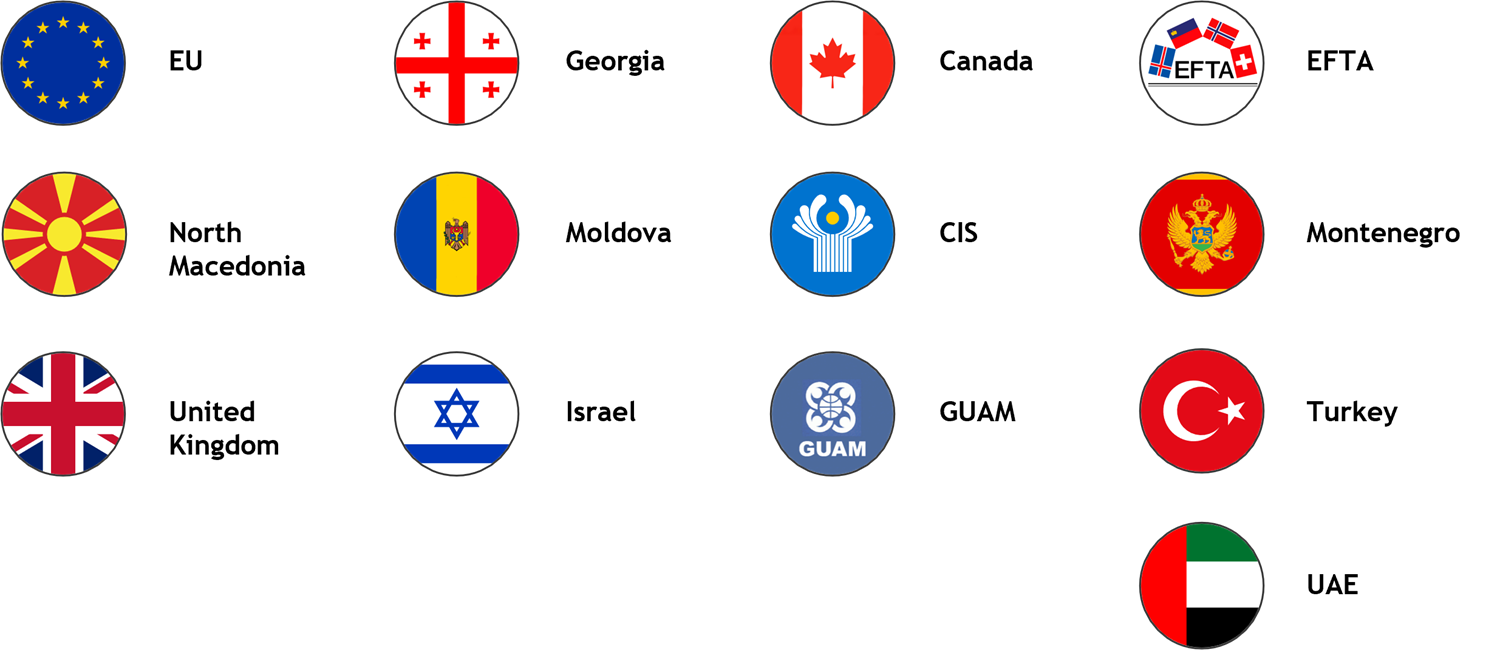
1. UPDATED FREE TRADE AGREEMENT BETWEEN UKRAINE AND THE EFTA
Key changes:
• Complete abolition of duties on industrial products.
• Cancellation and reduction of duties on a significant part of agricultural goods:
- Iceland — 142 duty-free goods.
- Norway — 107 duty-free goods, 78 — with reduced rates.
- Switzerland and Liechtenstein — 427 duty-free goods, 163 with reduced rates.
• Overall growth in duty-free goods: 66.2%.
New sections of the Agreement:
• E-commerce: legal regulation of e-commerce, signatures, contracts, paperless trade.
• Small and medium-sized enterprises (SME): improved access to information, contact points, publication of information in English.
• Trade and sustainable development: environmental and social standards in trade relations.
Updated provisions:
• Trade in goods and SPS measures: aligned with WTO agreements.
• Simplification of trade procedures: transparency in licensing, clear rules for exporters.
• Public procurement: better access for Ukrainian suppliers to EFTA markets.
• Intellectual property: cooperation and protection.
• Increased access of Ukrainian goods and services to the markets of the EFTA countries.
• Recovery of the Ukrainian economy.
• Strengthened economic cooperation and trade relations with Norway, Iceland, Switzerland and Liechtenstein.
• Promoting the modernisation and digitalisation of trade procedures to increase efficiency.
2. COMPREHENSIVE ECONOMIC PARTNERSHIP AGREEMENT BETWEEN UKRAINE AND THE UNITED ARAB EMIRATES (UAE)
• Free access of Ukrainian goods to the UAE market for 96.6% of product lines.
• Lifting of restrictions on foreign capital at 49% for Ukraine, enabling entrepreneurs to register companies with up to 70% foreign ownership with a gradual increase to 100% in certain sector.
• Facilitation of digital trade and abolition of duties on electronic servicess.
• Establishment of the Ukraine-UAE Investment Council.
• Attracting investments from the UAE to Ukraine.
• Simplified company registration procedures for Ukrainian businesses in the UAE.
• Expansion of Ukrainian exports in key sectors, including metallurgy, food industry, particularly flour milling and oil production.
3. UPDATE OF THE AGREEMENT BETWEEN UKRAINE AND THE UNITED KINGDOM OF GREAT BRITAIN AND NORTHERN IRELAND ON POLITICAL COOPERATION, FREE TRADE AND STRATEGIC PARTNERSHIP
• Deeper tariff liberalisation: amendments to the Agreement on Political Cooperation, Free Trade and Strategic Partnership between Ukraine and the United Kingdom of Great Britain and Northern Ireland introduce the abolition of all import duties and tariff quotas in bilateral trade.
• The agreement remains in force until 31 March 2029, , except for two commodity items — eggs and poultry products — for which trade liberalization has been extended for an additional two years, until 1 April 2026.
• Investment incentives: The United Kingdom provides preferences to Ukrainian businesses and access to its financial markets.
• Expanding exports of Ukrainian agricultural products.
• Strengthening economic cooperation between the parties to the Agreement.
4. FREE TRADE AGREEMENT BETWEEN UKRAINE AND TURKEY
• Abolition of duties: Turkey cancels duties for 93.4% of industrial goods and 7.6% of agricultural goods from Ukraine. Ukraine abolishes duties for 56% of industrial goods from Turkey.
• Protection of domestic producers: Ukraine retains duties on scrap, used cars and second-hand goods.
• Establishment of a Joint Committee: To resolve disputes and monitor proper implementation of the agreement.
• Growth in bilateral trade, projected to reach USD 10 bln.
• Expanded opportunities for Ukrainian exporters, particularly in the industrial sector.
5. UPDATE ON THE UKRAINE-CANADA FREE TRADE AGREEMENT
• The modernized Canada–Ukraine Free Trade Agreement (CUFTA) eliminates tariffs on 99% of goods traded between Canada and Ukraine. Preferential tariffs apply only when rules of origin are met and exporters provide the required origin documentation and record‑keeping.
• Canada’s Tariff Finder can be used as a practical first step to estimate landed cost by HS code and to check tariff staging, tariff‑rate quotas (TRQs) and sensitive‑product rules.
• Liberalisation of trade in services and investments under a negative‑list approach, with sector‑specific reservations and exceptions.
• Digital Trade provisions include commitments on cross‑border data flows, limits on data localization and protections against forced source‑code disclosure (subject to defined exceptions).Enhanced Government Procurement rules aim to improve transparency and predictability for companies planning to participate in public tenders.
• Dedicated chapters on SMEs, Gender, and Indigenous peoples, promoting inclusive‑business practices and supporting ESG‑aligned strategies — valuable for shaping procurement narratives and sustainability positioning.
• Improved market access for Canadian and Ukrainian goods and services, supported by clearer and more predictable trade conditions.
• Increased participation of Canadian companies in Ukraine’s recovery‑related projects, including public procurement and service delivery.
• Strengthened commitment to inclusive and responsible business practices aligned with ESG considerations.
• In 2023, total bilateral trade between Canada and Ukraine grew by more than 55% to approximately CAD 695 mln. Canadian exports to Ukraine reached about CAD 344 mln in 2024, underscoring the expanding role of Canadian suppliers in the Ukrainian market.

US-Ukraine Reconstruction Investment Fund
On 8 May 2025, the Verkhovna Rada of Ukraine ratified the Agreement between the Government of Ukraine and the Government of the United States of America on establishing the US-Ukraine Reconstruction Investment Fund. This Agreement is the first of three planned international legal instruments designed to lay the foundation for long-term bilateral cooperation in subsoil use, investment, and energy security.
Declarative in nature, the Agreement reaffirms and strengthens the strategic partnership between the Parties, supporting Ukraine’s long-term reconstruction and modernisation in response to the widespread devastation caused by russia’s full-scale invasion and advancing the vision of a peaceful, sovereign, and resilient Ukraine.
Reconstruction Investment Fund — a pivotal mechanism designed to attract investment for Ukraine’s economic recovery and to strengthen the strategic partnership between the two nations.
Key aspects of the Agreement
Tax and Trade Guarantees: The Agreement exempts the Partnership from taxation in both Ukraine and the United States with respect to income and payments arising from investment activities in Ukraine. In addition, the United States expects not to apply trade restrictions to resources acquired within the Partnership’s projects.
Partnership Financing: The Government of Ukraine contributes to the Partnership through an irrevocable right to receive the Agreed Ukraine Income, transferred via a designated state budget fund. Each Party contributes in accordance with the Limited Partnership Agreement, with the U.S. contribution eligible for increase depending on the value of any additional military assistance provided to Ukraine.
Partnership’s Priority Access to Investment Opportunities: Ukrainian authorities must include provisions in relevant permits and contracts to ensure that the Partnership receives priority access to investment-related information in the subsoil use and infrastructure sectors. If the Partnership expresses interest in a project, it must be engaged in good-faith negotiations, and no more favorable terms may be offered to third parties. All measures must comply with Ukrainian legislation and the country’s obligations to the EU.
Preferential Right to Purchase Extractive Output: The Partnership is granted the right to negotiate the purchase of extractive products on market terms. Ukrainian authorities must ensure that no third party is provided with more advantageous conditions.
Alignment with EU Accession Commitments: If new obligations arising from Ukraine’s EU accession affect the Agreement, the Parties will engage in good-faith negotiations to introduce the necessary amendments.
Ukraine-Agreed Revenue: Defined as 50% of royalties, license fees, and rental payments received by Ukrainian state authorities from:
▪️ New subsoil licenses or special permits issued after the Limited Partnership Agreement enters into force
▪️ Previously issued licenses that have not yet been industrially exploited as of that date
❗️Excludes any revenue originating from the Partnership or reparations from russia
On 5 November 2025, the Cabinet of Ministers of Ukraine adopted a resolution regulating the implementation of the Agreement between the Government of Ukraine and the Government of the United States of America on the establishment of the US-Ukraine Reconstruction Investment Fund.
Main points:
Project categories:
Projects involving the use of natural resource assets based on special subsoil use permits issued after 23 May 2025, or permits amended after this date to include new natural resource assets. Such activities include:
• Geological exploration.
• Exploration and industrial development.
• Extraction.
• Processing, production, and purification.
Projects involving the design, construction, operation or maintenance of infrastructure specifically intended to support the exploitation of one or more natural resource assets, including:
• Mining and processing plants.
• Inland water transport facilities, river ports (terminals).
• Seaports and terminals for transshipment of natural resources (except grain).
• Access roads and pipelines for transporting resources.
• Specialized industrial roads and other transport facilities.
• Logistics complexes and terminals.
• Oil refineries.
• Natural gas preparation, liquefaction and/or regasification facilities.
• Other infrastructure facilities that ensure the exploitation of natural resources.