

What you will learn from this article
- Why assessing direct losses does not reflect the full extent of a business’s losses.
- What loss of profits means and when compensation for such losses may be claimed.
- How loss of profits is calculated.
- What documents are required to substantiate loss of profits.
- How to prepare for submitting claims for compensation.
Why assessing direct losses is not enough
The direct losses trap
Russia’s armed aggression against Ukraine has caused catastrophic damage to Ukrainian businesses. Most Ukrainian companies that have faced the destruction of or damage to production facilities, warehouses or retail premises naturally begin documenting the harm suffered by assessing their actual (direct) losses. They commission technical inspections, prepare damage assessment reports, and determine the residual book value or replacement value of the physical assets that have been lost.However, financial analysts and valuation professionals understand that focusing solely on the value of destroyed physical assets may significantly understate the true economic impact of the loss. Focusing solely on the value of bricks, concrete structures or machinery overlooks an asset’s fundamental ability to generate cash flows. When a business loses a grain elevator, manufacturing plant or shopping centre, it loses more than just the value of the construction materials and equipment. It may also lose profitability, contracts and market share and, most importantly, the future profits that the asset could have generated during the period of forced downtime.
Ignoring loss of profits when preparing a claims portfolio, bringing legal proceedings or pursuing claims through international arbitration may deprive a business of a significant portion of the financial resources needed for recovery. As financial advisers and valuation professionals, our aim is to convey a clear message to C-suite executives and business owners:
assessing loss of profits is not an optional extra, but an essential element in restoring economic justice.
The principle of restitutio in integrum: why property damage is only the tip of the iceberg
International law and valuation practice are guided by the principle of restitutio in integrum (full reparation / restoration to the original position). Under this principle, the injured party should be placed in the financial position it would have been in had the wrongful act (armed aggression) not occurred.From a financial analysis perspective, the value of any commercial business is equal to the present value of its future cash flows. Damage to a physical asset is merely the cause, while the consequence is the complete or partial disruption of the operating cycle.
Where a company limits its assessment to direct losses, the business is effectively valued based on liquidation or replacement principles, without taking into account its existing business model and going concern status. Loss of profits reflects the period during which the owner’s capital remained “frozen” or was destroyed and was therefore unable to generate returns through business operations.
In the case of commercial real estate, integrated property complexes, agricultural enterprises and infrastructure assets, loss of profits can often exceed the book value or replacement cost of the physical assets.
In practice, loss of profits cannot be determined based on purely theoretical profit that might have been earned. The calculation should be based on verified financial indicators, the company’s historical performance, the asset’s operating capacity, and a reasonable period required for its restoration. This is why the valuation methodology establishes clear eligibility criteria, principles for modelling income, and rules for discounting cash flows to a single valuation date.
Methodological framework for assessing loss of profits: from concept to mathematics
The application of methodologies for assessing loss of profits is based on the provisions of the National Valuation Standards (NVS 1–4), the International Valuation Standards (IVS), the World Bank Group guidelines on damage assessment and recovery following disasters and conflicts, as well as the provisions of the Procedure approved by Resolution of the Cabinet of Ministers of Ukraine No. 326, as amended by Resolution No. 951.Below, we consider the key methodological principles and the approach to calculating loss of profits, which provide an objective basis for presenting such calculations to international auditors, courts and compensation commissions.
General methodological guidelines
- Functional currency: The calculations are performed in US dollars (USD) as a hard currency, thereby mitigating the effects of domestic inflation and significant devaluation of the national currency during the period of martial law. The resulting amount is converted into Ukrainian hryvnia at the official NBU exchange rate as of the valuation date.
- Time value of money: Cash flows that the business would have generated monthly during the downtime period are compounded to the valuation date (i.e. accumulated using compound interest). Where appropriate, a combination of compounding and discounting is applied.
Eligibility criteria: when can loss of profits be assessed?
The methodology sets out strict eligibility criteria designed to exclude fictitious or inherently loss-making business models:
- Loss of profits is assessed exclusively in relation to assets with economic potential (investment property, agricultural complexes, integrated property complexes, corporate rights, etc.).
- Strict profitability criterion: If, according to the company’s official financial statements, it was loss-making in both 2020 and 2021, no loss of profits is assessed. Loss of profits cannot be abstract or hypothetical; the assessment must be based on a demonstrated track record of profitability.
Modelling baseline income
The baseline amount of loss of profits is calculated using earnings before tax (EBT) for the two pre-war years, 2020 and 2021.
Methodological considerations:
- If EBT was negative in either year, the amount for that year is set at zero for the purpose of calculating the average.
- If the company commenced operations only in 2020, the 2021 EBT figure is used as the baseline.
- For partially damaged facilities, the calculation is performed in proportion to the share of the operating capacity attributable to the business units that have lost their ability to operate.
Important: When assessing loss of profits, terminal value is not calculated, as the assessment covers only the specific period during which control was involuntarily lost.
Compensation period (compounding period)
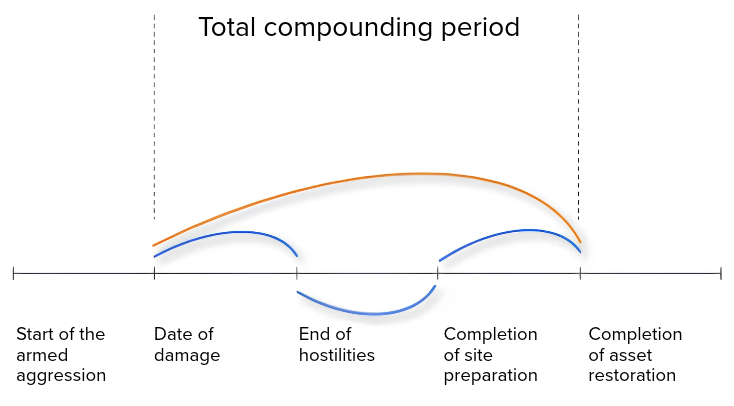
One of the most challenging tasks for the valuer and the Chief Financial Officer (CFO) is to substantiate the period over which loss of profits is calculated. The model takes into account not only the actual period of hostilities, but also the time technically required for demining, site clearance, and construction and installation works before the facility can be put back into operation.
Financial mathematics of compounding and discounting in the assessment of loss of profits
Since the affected business would have generated cash flows progressively (monthly), the accumulated losses need to be brought to a single valuation date using a compounding rate.As the base compounding rate, the methodology applies a rate of return that reflects the time value of money and Ukraine’s sovereign risk premium. This rate is set at 8.61% per annum, corresponding to the weighted average yield on Ukrainian Eurobonds maturing in 2032 over the period from November 2021 to January 2022
.
If the valuation date precedes the end of the compounding period, the portion of future cash flows relating to the period from the valuation date until the completion of restoration is discounted using a rate that reflects the operating risks specific to the asset.
In simplified terms, the assessment of loss of profits is based on determining the profit that the business would have earned under normal operating conditions had the asset not been damaged or destroyed. The resulting amount is then adjusted to reflect the actual duration of downtime, the proportion of operating capacity lost, and the time value of money.
Thus, the calculation comprises three key elements:
- Determining the business’s baseline level of profitability
- Determining the period during which the asset was unable to generate income
- Bringing the lost cash flows to the valuation date by applying the appropriate compounding or discount rate
Evidentiary requirements and practical pitfalls for the C-Suite in assessing loss of profits
International arbitration and valuation practice follows a clear principle: loss of profits cannot be abstract. The evidentiary requirements for claims seeking compensation for loss of profits are significantly more stringent than those applicable to direct losses. A court or compensation commission must be satisfied that the income would in fact have been generated had the armed aggression not occurred.
Common mistakes businesses make when preparing for a valuation:
- Lack of pre-war source documentation: The loss of accounting records, ERP system data, or Forms No. 1 and No. 2 of financial statements for 2020–2021 makes it impossible to perform the calculation. Management should therefore take steps now to restore the company’s official financial records and ensure that they are securely backed up in cloud storage.
- Attempting to support the calculation with “aggressive growth plans”: Loss of profits cannot be calculated based on optimistic investor presentations projecting multiple-fold growth in 2022–2023. The methodology explicitly links the baseline income to verified financial performance for 2020–2021.
- Failure to account for partial operations: If, following damage to one of its three production facilities, the business continued to operate at 60% of its capacity, the calculation should clearly distinguish operating expenses and revenue attributable to individual production lines or business units.
- Unsubstantiated restoration periods: Overstating the time required for the technical restoration of a facility without reference to applicable construction standards or an independent construction and technical expert assessment is one of the most vulnerable aspects of a business’s position in court proceedings.
Documents to retain or restore
To substantiate the calculation of loss of profits, businesses should proactively compile a separate package of supporting evidence, including:
· financial statements for pre-war periods;
· accounting records and management accounts;
· data from ERP and CRM systems;
· contracts with key customers and suppliers;
· evidence of actual production or sales volumes;
· documents confirming production capacity utilisation;
· records issued by the State Emergency Service of Ukraine, extracts from the Unified Register of Pre-Trial Investigations, and other documents confirming the occurrence of damage;
· photographic and video evidence and satellite imagery;
· technical reports on the condition of the facility;
· expert assessments of the time required for restoration or reconstruction;
· documents confirming the partial continuation of business operations following damage to the asset.
The more comprehensive the supporting evidence, the easier it is to establish a causal link between the damage to the asset and the income lost by the business.
A strategic roadmap for CFOs and business owners
The assessment of loss of profits serves as a strategic bridge between physical damage or destruction and the actual financial recovery of a business. To turn potential claims into legally defensible and financially substantiated claims, the company’s financial management should follow the steps below:
- Document the legal and physical aspects of the damage: obtain reports issued by the State Emergency Service of Ukraine, extracts from the Unified Register of Pre-Trial Investigations (URPTI), photographic and video evidence, and satellite imagery.
- Audit pre-war financial data: verify the availability and accuracy of financial statements for 2020–2021 and ensure that the profitability criterion is met (EBT > 0).
- Commission an independent construction expert assessment: obtain formal expert conclusions on the required timeframe and stages of restoration, including site clearance, demining, and construction works.
- Obtain formal expert conclusions on the required timeframe and stages for restoring the property, including site clearance, demining, and construction works.
- Engage certified valuers and properly define the scope of the valuation.
- Include loss of profits in the relevant register of damage: compile a comprehensive claims portfolio for submission to the International Register of Damage, national authorities, or international arbitration tribunals.
It is important to remember that direct losses reflect what you lost yesterday. Loss of profits reflects what you would have earned tomorrow.
Sources and regulatory framework
When assessing loss of profits and compiling supporting evidence, businesses should take into consideration the provisions of applicable Ukrainian and international valuation methodologies and standards, including:
· the Procedure for Determining Damage and Losses Caused to Ukraine as a Result of the Armed Aggression of the Russian Federation, approved by Resolution No. 326 of the Cabinet of Ministers of Ukraine;
· relevant amendments to the above Procedure, including those introduced by Resolution No. 951 of the Cabinet of Ministers of Ukraine;
· National Valuation Standards Nos. 1–4;
· International Valuation Standards (IVS);
· methodological and analytical materials developed by the World Bank Group on the assessment of damage, losses, and recovery needs.
For each specific case, the applicable regulatory and methodological sources may vary depending on the type of asset, the nature of the damage, and the jurisdiction in which the claim is intended to be submitted.
How can BDO in Ukraine help?
The BDO in Ukraine team helps businesses comprehensively assess the economic impact of damage to or loss of assets, from determining direct losses and assessing loss of profits to compiling financially substantiated supporting evidence.Our professionals can assist with analysing financial information, modelling lost cash flows, determining the restoration period, conducting independent valuations, and preparing supporting materials for national and international compensation procedures.
Discuss the assessment of damage and loss of profits with BDO in Ukraine professionals.