

Russia’s full-scale invasion of Ukraine has fundamentally reshaped the landscape of corporate finance and asset valuation. CFOs, valuation professionals, and auditors have faced a reality in which traditional discounted cash flow models and conventional approaches to impairment testing under IAS 36 have become far less effective in their standard form.
The loss of legal or effective control over facilities in temporarily occupied territories, physical damage to assets caused by military attacks, power shortages, and the reconfiguration of supply chains have created an unprecedented level of uncertainty.
Under International Accounting Standard (IAS) 36, Impairment of Assets, entities are required to assess at each reporting date whether there are any indicators of impairment, that is, whether there are signs that the recoverable amount of an asset or a cash-generating unit (CGU) may have declined. In a wartime environment, impairment indicators are both evident and pervasive. However, the key challenge lies not so much in identifying the effects of damage and disruption, but in clearly distinguishing between asset derecognition or write-off under IAS 16, deconsolidation under IFRS 10, and impairment under IAS 36, as well as the appropriate valuation and modelling of fair value and value in use.
Analysis of the impact of wartime factors on operations
To build a robust impairment testing model, it is essential to first distinguish the various wartime factors and understand their direct impact on the balance sheet and the company’s operating performance. This analysis is one of the key stages of asset valuation in a wartime environment.Classification of asset status
- Physically damaged or destroyed assets: where an asset cannot be restored or its economic value has effectively been reduced to zero, apply derecognition (write-off) in accordance with IAS 16 Property, Plant and Equipment rather than performing an impairment test under IAS 36.
- Assets located in temporarily occupied territories or areas affected by active hostilities: the key consideration is whether control exists in accordance with IFRS 10 Consolidated Financial Statements. Where an entity has lost access to the assets and is no longer able to direct their use or obtain economic benefits from them, this may give rise to the need to deconsolidate subsidiaries or recognise a full impairment of their carrying amount.
- Operating assets located in territories under Ukrainian government control: although not directly affected by occupation or destruction, these assets remain exposed to the indirect effects of wartime risks. These may include production interruptions caused by air raid alerts, electricity shortages, higher capital and operating expenditures related to backup power solutions, increased logistics costs, staff mobilisation, and weakened domestic demand. This category of assets is subject to the traditional IAS 36 impairment test, adapted to reflect the realities and uncertainties of a wartime environment.
Restructuring cash-generating units (CGUs)
Wartime conditions often disrupt vertically integrated value chains. For example, if a beneficiation plant is in a temporarily occupied territory while the downstream steel plant remains in an area under Ukrainian government control, the steel plant may lose access to its primary source of raw materials and be forced to procure them externally at import-parity prices.Under IAS 36, a cash-generating unit (CGU) is the smallest identifiable group of assets that generates cash inflows largely independent of those generated by other assets or groups of assets. In a wartime environment, management must reassess the boundaries of CGUs. This may involve regrouping assets to reflect changes in internal transfer pricing arrangements, combining or separating individual units, and reviewing the allocation of goodwill, which is typically the first asset written down when an impairment loss is recognised.
Valuation focus: modelling value in a wartime environment
Under IAS 36, the recoverable amount is determined as the higher of two values: fair value less costs of disposal (FVLCOD) and value in use (VIU).Fair value is measured in accordance with IFRS 13 and the International Valuation Standards (IVS) and reflects the assumptions that would be made by market participants. It takes into account elevated wartime risk discounts, the lack of comparable market transactions, and various asset realisation scenarios. Value in use (VIU), by contrast, represents an entity-specific assessment based on discounted cash flow projections. Unlike fair value, it is subject to strict limitations on the inclusion of future capital expenditures related to expansion projects or planned restructurings.
Multi-scenario cash flow modelling
The traditional valuation approach is based on the development of a single base-case cash flow projection. In a wartime environment, however, reliance on a single scenario is no longer sufficient. IFRS 13 and the guidance provided by IAS 36 require the use of a probability-weighted approach when estimating expected future cash flows.Expected cash flows are calculated as the weighted average of cash flows under each potential scenario, multiplied by the probability of that scenario occurring. In practice, valuation professionals should typically model at least three key scenarios:
- Pessimistic scenario: prolonged intense hostilities, further damage to infrastructure, a 30-50% decline in sales volumes, and elevated costs associated with achieving energy independence;
- Base-case scenario: continuation of the current status quo, gradual adaptation of logistics networks, moderate inflation, and the maintenance of operating margins;
- Optimistic scenario: cessation of active hostilities, the launch of large-scale reconstruction efforts, and the reopening of maritime and air transport routes.
Important consideration: capital expenditures (CapEx)
When calculating value in use (VIU), future cash flows must exclude capital expenditures that would enhance or expand an asset’s performance, as well as the related future economic benefits. Only expenditures required to maintain the asset in its current operating condition may be included.When determining fair value less costs of disposal (FVLCOD), however, market participants may take into consideration future investments in restoration or modernisation if such investments are expected to increase the overall market value of the asset.
Discount rate (WACC) and its components
Calculating the weighted average cost of capital (WACC) in a country affected by armed conflict requires a thorough decomposition of the cost of equity and the cost of debt.The cost of equity is typically estimated using an expanded Capital Asset Pricing Model (CAPM). It consists of several key components:
- Risk-free rate: typically based on the yield of 10-year U.S. government bonds;
- Industry risk: reflected through a levered beta coefficient adjusted for the company’s capital structure;
- Country risk premium and wartime risk premium: one of the key challenges is avoiding the double counting of risks. If the operational effects of the war, such as declining sales or rising costs, have already been incorporated into the cash flow projections, including the same risks again in the discount rate premium will artificially and unjustifiably reduce the value of the asset. Under IAS 36, assumptions reflected in the discount rate should not duplicate adjustments already incorporated into the cash flows.
- Misstating the risk-free rate: using the yield on Ukrainian Eurobonds as the risk-free rate is methodologically inappropriate, as these instruments already incorporate a significant sovereign default spread. A more appropriate approach is to use U.S. Treasury yields as the risk-free rate and reflect sovereign risk entirely through the country risk premium;
- Currency and inflation consistency: if cash flows are modelled in a hard currency (such as USD or EUR), the discount rate should also be determined in that currency. For cash flows denominated in Ukrainian hryvnia, the discount rate must be adjusted to reflect the inflation differential.
Limitations of the market approach and the use of valuation multiples
Under IVS 200, the market approach faces significant limitations in the current environment.Valuation multiples derived from comparable publicly traded companies in emerging markets, such as Poland or Romania, cannot be applied without substantial adjustments for country-specific risk. At the same time, the volume of domestic M&A transactions in Ukraine remains extremely limited, and many transactions that do occur are distressed sales rather than arm’s-length market transactions. Under IFRS 13, forced or distressed sales are not representative of fair value, as they do not reflect an orderly transaction between market participants.
When applying the asset-based approach (net asset value), a full inventory review and revaluation of each item of property, plant and equipment is required. This process should be supported by certified valuation professionals who assess not only physical depreciation, but also external (economic) obsolescence arising from declining industry demand and increased operating risks.
Regulatory and methodological framework
When preparing financial statements and valuation reports in a wartime environment, valuation professionals and CFOs must ensure consistency between two interconnected regulatory frameworks:
- International Financial Reporting Standards (IFRS):
o IAS 36 sets out the requirements for impairment testing, the determination of estimated recoverable amount, and the allocation of impairment losses;
o IFRS 13 establishes the framework for fair value measurement and the application of probability-weighted valuation techniques;
o IFRS 10 governs the assessment of control and the deconsolidation of subsidiaries;
o IAS 16 applies to the derecognition of physically destroyed assets.
- Valuation standards (IVS / RICS):
o IVS 104 Bases of Value distinguishes between fair value, market value, and investment value;
o IVS 200 sets out the requirements for the valuation of businesses and equity interests;
o The RICS Red Book provides a framework for professional ethics, procedural transparency, and valuation practice in conditions of heightened market uncertainty.
The boundary between deconsolidation (IFRS 10) and impairment (IAS 36).
When reviewing financial statements, auditors pay particular attention to the correct application of the relevant standard:
- If an entity has completely lost operational and legal control over a subsidiary located in an occupied territory, it must deconsolidate the subsidiary’s assets in accordance with IFRS 10 and recognise the resulting gain or loss from the loss of control in profit or loss;
- If control is retained, but the asset is located in a high-risk area or operations have been suspended, an impairment test should be performed under IAS 36, with any impairment loss recognised as the difference between the carrying amount and the estimated recoverable amount.
Practical application of IAS 36: an illustrative example
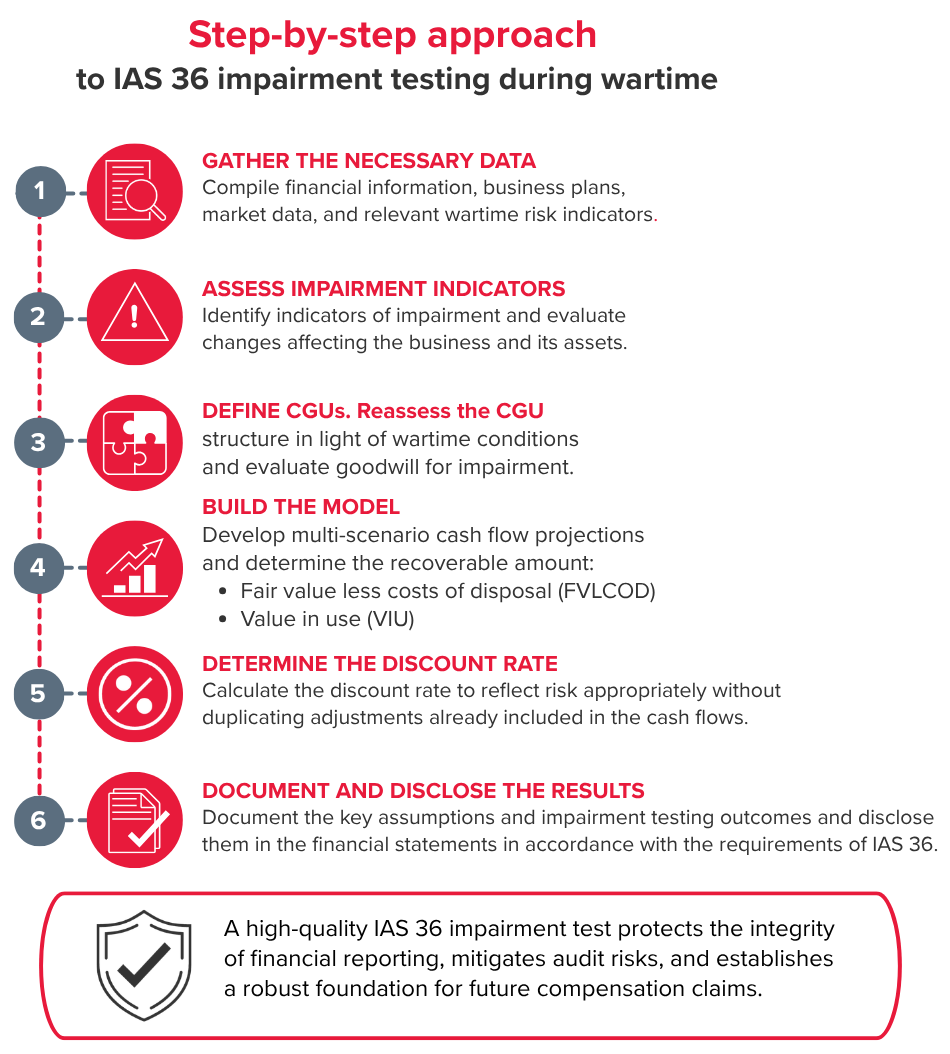
Practical recommendations for CFOs, valuation professionals, and auditors.To support a successful audit process and ensure a robust impairment assessment, company management should follow the step-by-step approach outlined below:
- Conduct a detailed review of asset status: classify assets into those that have been destroyed (subject to derecognition under IAS 16), those lost due to occupation (requiring assessment for deconsolidation under IFRS 10), and operating assets affected by wartime factors (subject to impairment testing under IAS 36);
- Reassess the CGU structure: determine whether individual business units or production lines remain capable of generating independent cash flows following disruptions to supply chains or logistics networks.
- Implement probability-weighted modelling: move beyond a single-scenario analysis and develop at least three scenarios (pessimistic, base-case, and optimistic), supported by a transparent rationale for the assigned probability weightings;
- Review WACC for potential double counting: ensure that wartime risks already reflected in cash flow projections are not incorporated again through risk premiums in the discount rate;
- Engage independent valuation professionals: support fair value assessments and the measurement of external obsolescence with professional valuation reports prepared in accordance with international standards.
Disclosure of key estimates and judgements
When reviewing financial statements, auditors place particular emphasis on the disclosure of key estimates and judgements. Management is expected to provide clear and comprehensive disclosures in the notes to the financial statements regarding:- The scenarios used in the assessment and the probability weightings assigned to each of them;
- The discount rates applied to different CGUs and the methodology used to determine those rates;
- Sensitivity analyses showing how the valuation model responds to changes in key assumptions, including operating profit performance, WACC, and capital expenditure levels;
- The extent to which impairment losses may be irreversible, as well as the status of claims submitted for compensation of war-related damages. In accordance with IAS 37, potential reparations or compensation claims are not recognised as assets until their receipt is considered probable.
A well-prepared and thoroughly documented IAS 36 impairment test not only supports the integrity of financial reporting during an audit but also provides a robust legal and valuation foundation for future international arbitration proceedings related to damages caused by armed conflict.
Need assistance with asset impairment testing?
If your company is performing an IAS 36 impairment test, reassessing its CGU structure, determining recoverable amount, or seeking support in substantiating key assumptions and discount rates, our professionals are here to help. We can assist in evaluating the impact of wartime factors on assets, developing a robust and supportable valuation model, and preparing documentation that stands up to audit scrutiny.Contact us for further guidance and support.