

Andrii Borenkov, CFA
Partner, Head of Advisory

BDO in Ukraine carries out independent external audits and advises qualified providers of electronic trust services (QPETS) on the requirements of NBU Board Resolution No. 116 of 19 September 2019. The requirements apply to QEPs whose details have been entered into the Trusted List upon recommendation by the NBU’s certification centre, as well as to organisations planning to obtain such status. The Regulation requires an audit of compliance with its requirements to be carried out at least once a year. We assess organisational and technical security measures, access and key management, logging, business continuity and internal documentation. The client receives a gap analysis report detailing identified non-conformities and practical recommendations for rectifying them.
Requirements for qualified electronic trust service providers are more than a formality. Supervisory practice in Ukraine has already demonstrated the consequences of gaps in security.
Inspections of ETSP have identified cases in which providers operated without an adequate information security system, breached identification procedures or maintained internal regulations that did not comply with established requirements. According to the regulator, these deficiencies created conditions in which users’ private keys could be compromised. In one case, the violations resulted in the provider being removed from the Trusted List.
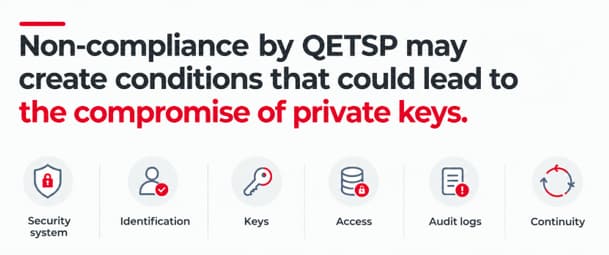
QETSP oversight therefore focuses not on a single document or technical measure, but on the entire chain of trust, from key protection and access management to logging, information security and continuity of service. BDO in Ukraine provides audit, compliance assessment and advisory services to qualified electronic trust service providers (QETSP) whose details are included in the Trusted List upon submission by the Certification Centre of the National Bank of Ukraine and which are subject to NBU Board Resolution No. 116.
The Regulation sets out requirements governing these providers’ operations, including the organisation of electronic trust services, information security, information protection, access management, the use and protection of private keys, audit logging, business continuity and internal documentation.
Resolution No. 116 also requires an internal or external audit of compliance with the Regulation at least once a year.
BDO in Ukraine helps QETSPs undergo an independent external audit against the established requirements, identify areas of potential non-compliance and risks, and prepare to meet regulatory requirements.
This service is intended for qualified electronic trust service providers included in the Trusted List upon submission by the Certification Centre, as well as organisations planning to obtain appropriate status.
QETSP provide qualified electronic trust services, which may include services related to the creation, verification and validation of qualified electronic signatures and seals; the issuance and verification of qualified public key certificates; electronic timestamps; and other qualified electronic trust services.
The current list of qualified trust service providers is available in the Trusted List maintained by the Central Certification Authority.
Resolution No. 116 establishes a comprehensive framework of organisational, technological and security requirements for qualified electronic trust service providers.
These requirements cover the organisation of QETSP operations and information and communications infrastructure, trust service delivery procedures, information and key protection, access management, the allocation of roles and responsibilities, audit logging, and business continuity.
In particular, QETSP are required to protect information by implementing an information security management system and/or an integrated information security system with confirmed compliance.
The Regulation also requires an audit of compliance with its provisions to be conducted at least once a year.
An independent assessment is conducted of the QETSP compliance with Regulation No. 116. The review covers the organisational, technological and security aspects of the provider’s operations, as well as internal procedures, information systems and controls related to the provision of electronic trust services.
The assessment covers approaches to protecting information processed within the QETSP information and communications system, as well as whether the implemented safeguards comply with regulatory requirements.
Particular attention is paid to processes for generating, storing, using, backing up and destroying QETSP private keys. Procedures for issuing, suspending, renewing and revoking qualified public key certificates may also be assessed.
Resolution No. 116 establishes requirements for maintaining audit logs of events within the QETSP information system, protecting them against unauthorised access, modification or destruction, and ensuring their backup and retention. The assessment determines whether the implemented logging and control mechanisms meet these requirements and provide appropriate traceability of critical operations.
The assessment examines the QETSP readiness to ensure the continuous provision of electronic trust services in critical situations. It may include a review of business continuity and recovery plans, backup infrastructure, response procedures and defined service recovery deadlines.
Internal policies, procedures, regulations, job descriptions and other documentation governing the QETSP operations are assessed. Particular attention is paid to clearly defining the roles, authority and responsibilities of employees involved in providing electronic trust services and ensuring information security.
The assessment identifies gaps between the current state of the QETSP systems, processes and controls and the requirements of NBU Resolution No. 116. The client receives a list of identified risks and practical recommendations for addressing them.
NBU Resolution No. 116 requires a qualified provider to arrange an internal or external audit of compliance with the Regulation at least once a year.
Following the audit, the QETSP should submit the audit report to the Certification Centre no later than five business days after the audit is completed.
An external audit provides an independent professional assessment of the current level of compliance, identifies potential non-compliances and determines practical measures to address them.
The client receives a structured assessment of the QETSP compliance with NBU Resolution No. 116.
An external audit provides an independent view of compliance with Resolution No. 116 and helps identify potential non-compliances promptly.
The assessment combines regulatory requirements with practical aspects of information security, cybersecurity, IT risk and internal controls.
The review covers not isolated technical measures, but the full range of processes, systems, controls and documentation related to the provision of electronic trust services.
The audit produces not only a list of identified non-compliances, but also clear recommendations on next steps and priorities for addressing them..
The assessment considers the QETSP operations, the electronic trust services it provides, its information infrastructure and the applicable requirements of Resolution No. 116.
Internal policies, regulations, procedures, the allocation of roles and responsibilities, and processes related to the provision of electronic trust services are reviewed.
The review covers the implemented controls for information security, access management, key management, audit logging, backup and business continuity.
The current state is compared against the requirements of NBU Resolution No. 116, and areas requiring improvement are identified.
The audit findings and practical recommendations for addressing identified non-compliances are documented.
BDO in Ukraine helps QETSP to assess compliance with NBU Resolution No. 116, identify potential risks and determine priority measures to address them.
The team of BDO in Ukraine conducts an independent external audit, providing the client with an assessment of the current state, a gap analysis and practical recommendations for addressing identified non-compliances.
Contact BDO in Ukraine to prepare for your annual audit and ensure compliance with NBU Resolution No. 116.