
Valuation of Intangible Assets

Valuation of Intangible Assets — Determining the Market Value of Intellectual Property and Brands


Valuation of intangible assets is the professional determination of the market or other value of intangible assets that have no physical form but create significant economic value for a business.

Such assets include brands, trademarks, goodwill, patents, licences, copyrights, technical documentation, software, know-how, databases and rights to use them, and other intellectual property (IP).


When and who needs valuation of intangible assets

The service is relevant for companies and investors in the following cases:

  • Mergers and acquisitions (M&A), purchase or sale of a business
  • Preparation of financial statements and purchase price allocation
  • Tax purposes or transfer pricing
  • Attracting investors or financing
  • Management of intellectual property and intangible assets
  • Litigation and protection of IP rights
  • Strategic planning and business performance evaluation


The BDO network is a sponsor of the International Valuation Standards Council (IVSC), an independent, non‑profit international standard‑setting organisation that develops the International Valuation Standards (IVS) in the interests of transparency, consistency, and trust in valuation across global markets. For our clients, this means working with a team that is aligned with leading international approaches to the valuation of intangible assets and intellectual property, takes into consideration the evolution of global standards, and applies practices that enhance the robustness, comparability, and credibility of valuation outcomes—particularly for financial reporting, purchase price allocation, M&A transactions, tax purposes, investment attraction, and the protection of intellectual property rights.


What is included in the service

As part of its valuation of intangible asset services, BDO in Ukraine provides the following:

  • Identification and classification of intangible assets
  • Analysis of ownership rights and economic benefits
  • Market and industry environment research
  • Selection and application of appropriate valuation approaches
  • Financial modelling of future income
  • Preparation of a professional valuation report
  • Consultation on the results and their practical application


Stages of intangible asset valuation

1.   Setting the task and defining the purpose of valuation

Agreeing on the type of value, valuation date and format of the result.

2.   Identification of assets

Determining the structure of intangible assets and their role in the business.

3.   Collection and analysis of information

Analyse legal, financial and operational information.

4.   Selecting valuation approaches

Apply income, comparative or cost approaches.

5.   Calculating value and agreeing on results

Exercise professional judgement on the final value.

6.   Preparing the report

Present the results in a structured report.


What the customer will receive

As a result of the cooperation, the customer will receive the following:

An official report on the valuation of intangible assets

✔ A justified market or other specified value of assets

✔ A document suitable for audits, financial reporting, courts and tax authorities

✔ Expert recommendations on the management and monetisation of intangible assets


Benefits of working with BDO in Ukraine 
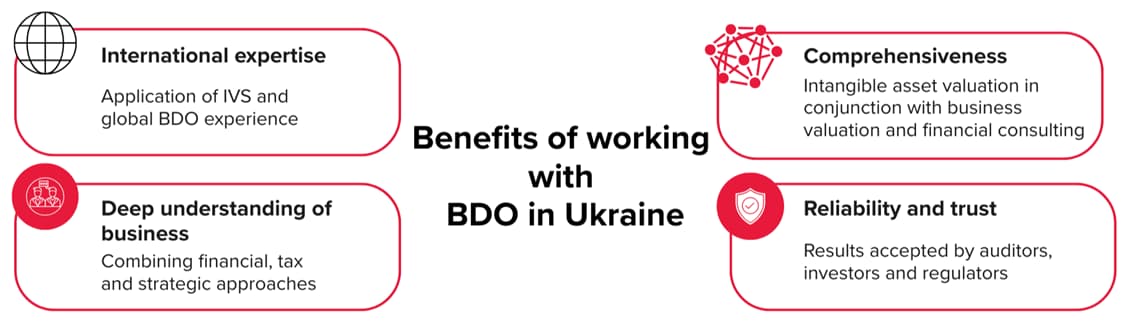
Infographic illustrating the benefits of collaborating with BDO in Ukraine in the context of intangible asset valuation: international expertise, deep understanding of business, comprehensive valuation, reliability and trust.


Ready to order an intangible asset valuation?

Contact the team of BDO in Ukraine for a professional valuation of your intellectual property and intangible assets, tailored to the specifics of your business.

Key Contact

Valeriy Afanasyev

Valeriy Afanasyev

Valuation Partner
View bio

FAQ (Frequently Asked Questions)

Intangible assets — assets without physical form that are identified, controlled by the company and capable of generating future economic benefits.

Valuation of intangible assets — the process of determining the value of intangible assets for financial, tax, legal or management purposes.

Intellectual property (IP) — rights to the results of intellectual activity, including patents, trademarks, copyrights and designs.

Brand — an intangible asset that reflects consumers’ perception of a company or product and influences revenue and customer loyalty.

Goodwill — the excess of the purchase price of a business over the market value of its identifiable net assets, reflecting business reputation and synergies.

Identifiability of an asset — the ability of an intangible asset to be separated or arise from contractual or legal rights.

Income approach — a valuation method that determines the value of an asset based on the expected future income it generates.

Comparative approach — a valuation method based on the analysis of market transactions involving similar intangible assets.

Cost approach — a valuation method that determines the value of an asset based on the cost of its creation or replacement.

Valuation date — the date on which the value of an intangible asset is determined.

Economic benefits — financial or strategic advantages that a company derives from the use of an intangible asset.

Useful life — the period during which an intangible asset can generate economic benefits.

Discounted cash flow — a method of converting future income to present value, factoring in risks.

International Valuation Standards (IVS) — uniform professional standards governing approaches and principles for asset valuation in international practice.