

Ukraine is gradually moving from broad declarations on its European path and sustainable development towards establishing a practical ESG regulatory framework, in which sustainability reporting, ESG risk management, corporate due diligence, the taxonomy of sustainable activities, and sustainable finance instruments operate as interconnected elements of a single system.
In 2024, the Government approved the Strategy for the Introduction of Sustainability Reporting by Enterprises, the financial sector received dedicated guidance through the White Paper on Managing Environmental, Social, and Governance (ESG) Risks, and the National Securities and Stock Market Commission presented the Sustainable Finance Roadmap for 2025–2030. In 2026, a draft of another, broader Roadmap for Implementing ESG Approaches and Sustainable Finance Instruments for 2026–2028 was put forward for public discussion.
Although the growing number of strategies, plans and roadmaps may seem complex, they are not competing initiatives. Rather, each serves a distinct purpose within the future ESG ecosystem. The 2024 Strategy addresses corporate sustainability reporting, the White Paper lays the foundation for ESG risk management in the financial sector, and the NSSMC Roadmap focuses on sustainable capital markets. The new draft government Roadmap brings these areas together, connecting them with the EU Taxonomy, corporate due diligence requirements, climate-related criteria for public investment, and mechanisms for monitoring sustainable financial flows.
For businesses, the debate is no longer about whether new requirements will emerge, but about their final scope, implementation timelines and the ability to transform fragmented ESG data into a structured, verifiable and reportable system.
What’s behind the new ESG and Sustainable Finance Roadmap?
Before looking at the substance of the Roadmap, it is worth noting that both the Roadmap itself and the accompanying Action Plan are still drafts. Key details of the future Cabinet of Ministers resolution have yet to be finalised, meaning the documents should be viewed as a proposed policy agenda for 2026–2028 rather than binding regulation.The scope of the draft extends well beyond ESG reporting, covering six closely linked areas that together form the foundation of the proposed framework.
The first area centres on the development of a national taxonomy of sustainable economic activities. Key measures include drafting the Law on the Taxonomy of Sustainable Economic Activities and Sustainable Investments by Q4 2026, introducing supporting rules on disclosures and technical criteria by Q4 2027, and preparing industry guidance and training resources for businesses, public authorities and financial institutions.
The second area addresses corporate sustainability due diligence. Key initiatives include preparing a National Action Plan on Business and Human Rights, translating the EU 2024/1760 Corporate Sustainability Due Diligence Directive (CSDDD), developing sector-specific guidance on value chain risks, and establishing a national grievance and alternative dispute resolution mechanism. The roadmap also targets the preparation of draft legislation by Q3 2028 to align Ukraine’s framework with the requirements of the CSDDD and the OECD Guidelines.
The third area focuses on embedding climate and environmental criteria into public investment processes. This includes developing methodologies for measuring the carbon footprint of investment projects, assessing their vulnerability to physical climate risks, and incorporating these tools into the digital system used to manage reconstruction efforts.
The fourth area introduces a framework for monitoring sustainable finance flows. This includes setting up data collection and information-sharing procedures for the authorities involved, introducing mechanisms to monitor public and private financial flows, and publishing an initial pilot report by Q4 2028. Alongside this, the Green Platform information portal is expected to be expanded to provide businesses with information on available financing programmes and practical guidance.
The fifth area covers the management of ESG risks across banks, non-bank financial institutions and capital markets. Planned measures include the introduction of a regulatory framework for ESG risk management in banks, guidance for non-bank financial institutions, ESG disclosure guidelines, the development of an ESG Scorecard, and amendments to capital markets regulation. The roadmap also supports the expansion of social bonds and the development of dedicated frameworks for issuing green, social and sustainable bonds.
The sixth area relates directly to sustainability reporting. Rather than creating a separate parallel framework, however, the roadmap builds on the implementation of the 2024 Strategy and calls for the preparation of a new operational plan for 2027–2030 by Q4 2026.
How does the Roadmap relate to the 2024 Strategy?
Adopted on 18 October 2024 by Resolution No. 1015-r of the Cabinet of Ministers of Ukraine, the Strategy established the foundation for sustainability reporting in Ukraine based on the European model. It envisages the inclusion of environmental, social and governance information in the management report, electronic reporting and public disclosure requirements, as well as the gradual introduction of independent assurance.In this respect, the Strategy sets out the core reporting requirements — determining who reports, what is reported and how information is disclosed. The new Roadmap takes a broader perspective, aiming to put in place the infrastructure that underpins an effective sustainability reporting system: a taxonomy for sustainable activities, ESG risk management frameworks, due diligence processes, data on sustainable finance flows, market disclosure mechanisms, and stronger institutional capacity within regulatory authorities.
There is also an important difference in scope between the two documents. While the 2024 Strategy is centred on developing the sustainability reporting framework—including legislative alignment, reporting standards, digital reporting formats and assurance requirements—the new Roadmap positions sustainability reporting as only one of six priority areas, with its further regulatory development deferred to a dedicated implementation plan for 2027–2030.
This suggests that the Roadmap does not replace the Strategy but rather expands its scope. Within this broader framework, ESG reporting is no longer treated as a standalone document produced once a year. Instead, it becomes the output of a system that manages risks, impacts, supply chains, investments and corporate data.
From Bill No. 13425 to Bill No. 13598: the current state of the reform
Ukraine’s first legislative effort to introduce the European model of sustainability reporting was made through government-sponsored Bill No. 13425. The proposal sought to establish the basic legal framework for the new reporting regime and align Ukrainian legislation with the requirements of the Corporate Sustainability Reporting Directive (CSRD). However, following changes in the Cabinet of Ministers, the bill was withdrawn, and its progress through Verkhovna Rada (Ukraine’s Parliament) ended before the legislative process could be completed.The withdrawal of Bill No. 13425 did not indicate a change in Ukraine’s approach to sustainability reporting or its commitment to approximation with EU law. Instead, it marked a procedural restart of the legislative process. This was followed by the registration of government-sponsored Bill No. 13598 in Parliament on 4 August 2025, titled “On Amendments to the Law of Ukraine “On Accounting and Financial Reporting in Ukraine” Regarding the Introduction of Sustainability Reporting”. In substance, the new bill continues the reform path established by its predecessor.
As of the date of this article, Bill No. 13598 has been included on Parliament’s agenda and is currently under review by the relevant committee. The bill proposes a legal framework governing the preparation, submission and disclosure of sustainability reports, revises the criteria used to classify companies into reporting categories, and clarifies certain reporting requirements for state-owned enterprises and other entities whose activities are of public interest.
Under the proposed framework, sustainability information would become a dedicated section of the management report instead of a standalone voluntary disclosure separate from corporate reporting. The framework is initially intended to apply to large undertakings and parent undertakings of large groups, before being extended to small and medium-sized undertakings whose securities are admitted to trading on regulated markets.
At the same time, Bill No. 13598 does not yet represent the final regulatory model. The parliamentary review process may result in changes to reporting timelines, scope criteria, transitional arrangements, and requirements for electronic filing and external assurance. Businesses should therefore distinguish between the broader direction of the reform, which is already well defined, and the specific compliance obligations that will be determined by the final legislation and implementing regulations.
How ready Is Ukraine to align with EU environmental legislation?
In BDO’s view, Ukraine has already defined a clear policy direction and put in place much of the conceptual framework required for the reform. Practical readiness, however, remains uneven across different areas.Among the strengths are the approved Strategy, the draft law on sustainability reporting, sector-specific initiatives developed by the National Bank of Ukraine and the NSSMC, the proposed taxonomy framework, a dedicated workstream for the implementation of the CSDDD, and recognition of the need to provide training for businesses and public authorities. The NSSMC Roadmap already includes ESG risk management, sustainability disclosure guidance, measures to combat greenwashing, an ESG Scorecard, the introduction of the ESRS, and the development of sustainable bonds.
The main gaps relate to completing the legislative implementation process, defining the responsibilities of competent authorities and supervisory mechanisms, ensuring consistency of requirements across regulators, strengthening professional capacity, developing an independent assurance system, building the necessary digital infrastructure, and improving companies’ ability to collect data across their value chains.
A further challenge lies in the evolving nature of the EU regulatory framework itself. The EU has already postponed the application of certain CSRD and CSDDD requirements under the so-called “stop-the-clock” mechanism. As a result, Ukraine is not aligning with a fixed set of rules, but with a regulatory framework that continues to evolve.
Against this backdrop, Ukraine appears ready for the next phase of regulatory alignment, though not yet for the simultaneous, full-scale implementation of all related requirements and procedures. This is precisely why the phased approach set out in the Roadmap appears justified. Its success, however, will depend on the timely adoption of legislation, the development of secondary regulations, and effective coordination among the Ministry of Finance, the Ministry of Economy, the National Bank of Ukraine, the NSSMC and other responsible institutions.
What should businesses be doing now?
Waiting for the final legislation without preparing in parallel is one of the biggest risks companies face. Building a reliable ESG data system within just a few months before the first reporting cycle is, in practice, extremely difficult. The report itself is only the final stage of a much broader process that includes assigning responsibilities, conducting a materiality assessment, defining methodologies, collecting historical data, developing policies, establishing internal controls and building the evidence base needed to support disclosures.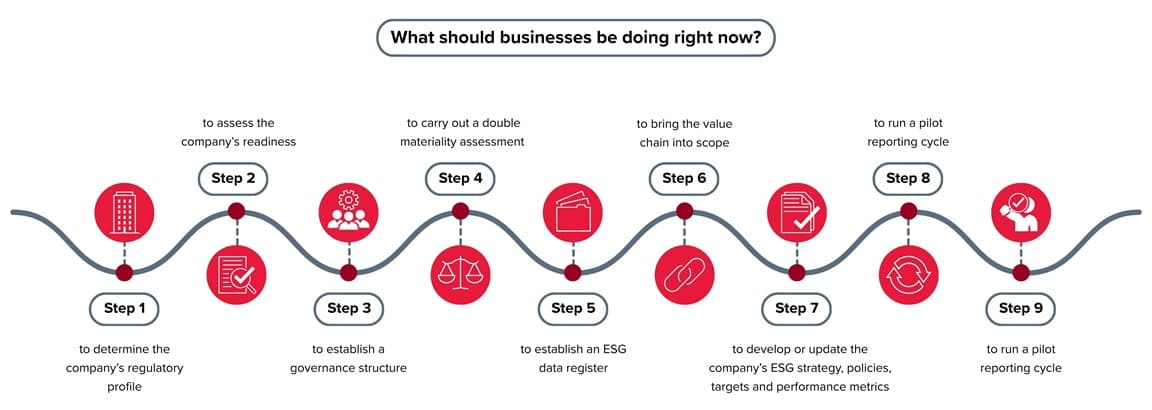
1 — to determine the company’s regulatory profile. This requires assessing factors such as company size, group structure, the presence of parent or subsidiary entities in the EU, issuer status, participation in international supply chains, and expectations set by banks, donors, investors and key customers.
2 — to assess the company’s readiness. This involves reviewing existing policies, processes, software solutions, metrics and internal controls against ESRS requirements, as well as evaluating preparedness for corporate due diligence on human rights and environmental matters.
3 — to establish a governance structure. Companies should appoint an executive with overall responsibility for ESG matters, set up a cross-functional ESG team involving finance, legal, HR, environmental, procurement, operations, risk and compliance functions, and clearly define data ownership responsibilities and escalation procedures.
4 — to carry out a double materiality assessment. Companies need to understand not only how environmental, social and governance factors may affect their financial performance, but also the actual or potential impacts their activities may have on people and the environment.
5 — to establish an ESG data register. For each metric, companies should identify the data source, methodology, collection frequency, responsible owner, unit of measurement, verification process and supporting documentation. Attention should be given to greenhouse gas emissions, resource consumption, occupational health and safety, workforce-related data, suppliers, grievances and compliance breaches.
6 — to bring the value chain into scope. Companies need to segment suppliers based on risk, incorporate ESG provisions into contracts and questionnaires, establish due diligence procedures, introduce reporting channels for potential violations, and define how adverse impacts will be identified and addressed.
7 — to develop or update the company’s ESG strategy, policies, targets and performance metrics. These should be embedded into budgeting, risk management, procurement, human resources, capital investment and performance management processes, rather than operating separately from day-to-day business activities.
8 — to run a pilot reporting cycle. Preparing a trial report or an internal disclosure package can help identify data gaps, inconsistent methodologies, weak controls and unsupported statements before sustainability reporting becomes a formal requirement.
9 — to prepare for external assurance. Every material statement and quantitative metric should be supported by a clear data source, a documented calculation method, a designated owner and a traceable audit trail.
This is precisely the type of process that benefits from support by specialists with expertise across the CSRD, ESRS, CSDDD, the EU Taxonomy, national legislation and independent assurance.
How can BDO in Ukraine help?
BDO in Ukraine supports businesses throughout their ESG transformation journey — from assessing readiness and understanding their regulatory profile to conducting double materiality assessments, developing ESG strategies, policies and roadmaps, establishing data collection systems, preparing sustainability reports in line with ESRS or GRI, training responsible personnel, and preparing information for independent assurance.The value of an integrated approach lies in helping companies build a structured and manageable ESG framework rather than simply producing a report to meet a formal requirement. Such a framework includes clearly defined responsibilities, metrics, controls, supporting evidence and a roadmap for continuous improvement.
Ukraine’s ESG regulatory transformation is still underway, but the direction of travel is already clear: sustainability reporting, sustainable finance, corporate due diligence and ESG risk management are gradually becoming parts of a single framework. Companies that begin building this framework before reporting requirements become mandatory will be better positioned not only for regulatory compliance, but also in their relationships with banks, investors, international partners and customers.
Learn more about BDO in Ukraine’s sustainability and ESG services and reach out to our experts to assess your company’s readiness, identify priority actions and develop a practical roadmap for meeting future requirements.