

Received a grant? The first step is to identify the specific type of independent review or audit required by your donor.
After receiving grant funding, many non-profit organisations, charitable foundations, and civil society organisations face the same question: is a grant audit required, or is an audit of the organisation’s financial statements sufficient?
In practice, these are not the same engagement and should not be treated as interchangeable.
Moreover, in many cases, donors do not require an audit of the recipient’s financial statements at all, as these are general-purpose financial statements prepared in accordance with applicable accounting frameworks such as National Accounting Standards (NAS), IFRS, or US GAAP. Donor requirements vary and may differ depending on the policies and rules established by the funding organisation. The verification of project fund utilisation is typically determined by the project budget and may take several forms, including:
- Reporting and selective tests conducted by the donor’s financial controllers
- Audit of the project fund utilisation report
- Agreed-upon procedures (AUP) engagement based on information prepared by the grant recipient
- Other assurance engagements.
The latter three categories require the involvement of an independent third party, namely an external auditor.
For this reason, the first step after receiving a grant is to carefully review the requirements set out in the grant agreement and discuss any unclear provisions with the donor’s representatives.
How does a financial statement audit differ from a grant audit?
Although both services are performed by an independent auditor, they differ in their objective, scope, and intended users of the results.| Financial Statement Audit | Independent Grant Audit |
|---|---|
| Covers the organisation’s activities as a whole | Applies to a specific grant-funded project |
| Primary users: owners, management, lenders, and regulators | Primary user: the donor |
| Subject matter: the organisation’s financial statements | Subject matter is defined by the grant agreement |
| Reporting framework: IFRS, National Accounting Standards (NAS) | Reporting requirements are defined by the grant agreement or by separate guidelines provided by the donor. |
| Result: an auditor’s opinion on whether the financial statements present a true and fair view of the organisation’s financial position and performance. | The engagement may result in:
|
In practice, even if an organisation already undergoes an annual financial statement audit, this does not automatically mean that the donor’s requirements have been met.
What exactly might a donor require?
One of the most common mistakes is focusing solely on the word “audit” in the grant agreement.Donors use different approaches to independent verification and assurance engagements.
For example, a grant agreement may require:
- audit of the grant expenditure report;
- audit of special-purpose financial statements;
- agreed-upon procedures (AUP) engagement;
- independent verification of specific indicators;
- compliance engagement to assess adherence to the terms of the grant agreement;
- other assurance engagements.
It is the grant agreement itself that determines which international standard applies, the scope of work to be performed by the auditor, and the format of the report to be submitted to the donor.
How can you determine which type of verification your organisation needs?
Before engaging an auditor, we recommend answering a few key questions:1. What does the grant agreement specify?
The first step is to review:
- whether an independent verification is required;
- when it must be carried out;
- who is authorised to perform the engagement;
- what type of report must be submitted.
The donor may require verification of:
- only the grant expenditure report;
- specific categories of expenditure;
- procurement activities;
- personnel costs;
- budget implementation;
- compliance with the terms of the grant agreement.
3. Which standards are specified in the agreement?
Grant agreements may contain references to:
- International Standards on Auditing (ISA);
- International Standard on Related Services (ISRS 4400);
- International Standard on Assurance Engagements (ISAE 3000);
- donor-specific guidelines or procedures.
4. What document does the donor expect to receive?
Depending on the nature of the engagement, the deliverables may include:
- auditor’s report;
- report of factual findings on the results of agreed-upon procedures;
- management letter;
- assurance report;
- completed donor forms and questionnaires.
Most common mistakes made by non-profit organisations
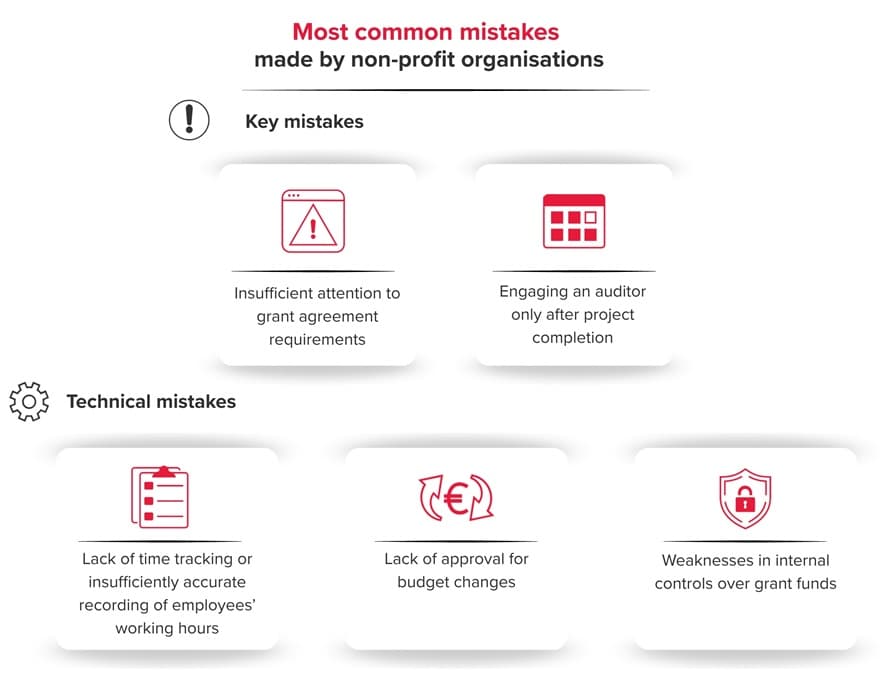
In practice, organisations often encounter several common situations.
- Insufficient attention to grant agreement requirements
- Engaging an auditor only after project completion
Among the most common technical issues are:
- Lack of time tracking or insufficiently accurate recording of employees’ working hours
- Lack of approval for budget changes
- Weaknesses in internal controls over grant funds
What documents should be prepared?
For most engagements, the auditor will require:- grant agreement and all amendments thereto;
- approved project budget;
- grant financial report;
- accounting records and ledgers;
- supporting documentation;
- timesheets and employment contracts;
- bank statements;
- supplier contracts and agreements;
- procurement documentation;
- documents supporting personnel-related costs (where applicable);
- correspondence relating to the approval of budget amendments or project changes;
- expenditure approval documentation.
Why is it important to determine the type of engagement before the audit begins?
Selecting the appropriate type of independent engagement from the outset helps organisations to:- meet donor requirements;
- avoid the need for additional audit or assurance work;
- submit required reports in a timely manner;
- optimise the cost of audit and assurance services;
- minimise the risk of donor findings or observations.
There is no universal concept of a “grant audit.” The type of independent engagement required is always determined by the terms of the grant agreement, the donor’s requirements, and the applicable international standards.
For this reason, before engaging an auditor, organisations should carefully review their grant documentation and determine which service is required: a financial statement audit, an audit of a grant expenditure report, an agreed-upon procedures engagement, or another type of assurance engagement.
When should you contact BDO in Ukraine?
It is advisable to engage an auditor not only after the completion of a grant-funded project, but also during the preparation phase of an independent engagement. This helps ensure the correct type of engagement is selected, the requirements of the grant agreement are properly assessed, and the necessary documentation is prepared in a timely manner.BDO in Ukraine provides independent grant verification services in accordance with the requirements of international donors and applicable international standards. We support non-profit organisations, charitable foundations, public associations, and international organisations in:
- identifying the provisions of grant agreements or terms of reference that should be considered when determining the requirements for an independent engagement;
- discussing donor requirements and recommending an appropriate type of audit or assurance engagement in accordance with applicable professional standards;
- performing independent engagements in accordance with donor requirements and international standards;
- preparing reports in the format specified by the grant documentation.
Not sure what type of independent engagement your grant-funded project requires?
Contact the experts at BDO in Ukraine. We can help you identify the grant documentation requirements that should be considered and discuss the possible scope and format of the independent engagement.