
OKRs (Objectives and Key Results) are effective for achieving quick results and fostering innovation. However, they do not facilitate holistic business management in times of war and uncertainty. Instead, the Balanced Scorecard (BSC) system, adapted for ESG factors, enables the systematic management of finances, customers, processes, people, and company sustainability.
The optimal approach for Ukrainian businesses is to use a combination of the BSC/ESG Scorecard for strategy, KPIs for operational efficiency and OKRs for breakthrough initiatives. This strikes a balance between the speed of change and long-term sustainability.
Many Ukrainian companies are currently enthusiastic about OKRs. This system appears modern, dynamic and “tech-savvy”. It is used by Google, IT companies, start-ups and innovative teams. OKRs have also become popular in Ukraine, particularly in the digital sector, in consulting and among product-oriented companies and businesses undergoing transformation.
However, an important question arises: is OKR really the best management system for Ukrainian businesses right now?
My answer is no. The reason is not that OKR is “bad” or outdated. The problem lies elsewhere. The logic of OKR is simply insufficient for the current conditions of Ukrainian business.
OKR origins: an evolution of MBO, not a new approach
It is also important to remember that OKR is neither a new system nor a Google invention. The modern version emerged at Intel in the 1970s, when Andy Grove adapted the traditional management by objectives approach to suit the dynamic environment of a technology company.
John Doerr learned about the OKR approach at Intel and, later becoming a venture capitalist, introduced it to Google in 1999. Google made OKR a world-renowned management practice. Therefore, OKR is more of a proven tool for execution of a culture than a new management revolution.
“For me, this topic is also very personal. Back in 2004, my thesis at the Kyiv-Mohyla Academy, in the Department of Political Science, was dedicated to the topic of the BSC in public administration. At the time, this seemed almost futuristic — talking about strategic management and systematic approaches to measuring the effectiveness of state institutions.
Later, when my publishing house, Balance Business Books, was up and running, we published virtually all the key books on the Balanced Scorecard in Ukraine. At that time, the BSC was considered one of the most powerful modern management concepts. However, the tide then turned as agile and lean approaches, OKRs, a growth culture and start-up thinking came to the fore. The Balanced Scorecard began to be labelled “old school”.
But now I see something interesting: it is precisely those systems that were created for long-term sustainability that are becoming relevant again”, notes Vira Savchenko, CEO at BDO in Ukraine.
OKR limitations: focus on short-term results
OKR was designed for environments of rapid growth and innovation. It provides the perfect answer to the question: “What should we focus on right now?” However, modern Ukraine is forcing businesses to ask much broader questions:— How can we maintain financial stability?
— How do we retain staff?
— How can we continue to operate in conditions of war and constant uncertainty?
— How do we maintain the trust of international partners and investors?
— How can we balance profitability, reputation, ESG (environmental, social and governance factors) and social responsibility?
— How can we ensure both development and stability at the same time?
Balanced Scorecard as a response to new challenges
This is precisely why the Balanced Scorecard, particularly its modern ESG adaptation, now seems more appropriate for Ukrainian companies.The Balanced Scorecard was developed by Robert Kaplan and David Norton back in the 1990s. For a long time, it was considered the “classic” strategic management system. However, the concept of the BSC has recently been given a new lease of life through ESG.
ESG transformation of BSC
In their article “Reimagining the Balanced Scorecard for the ESG Era” in the Harvard Business Review, Kaplan and David McMillan effectively reimagined the BSC for the ESG era.This is very telling. After all, the BSC proved flexible enough to integrate new requirements such as sustainability, stakeholder capitalism, governance, social impact and long-term trust.
This is where the key difference between the BSC and the OKR lies.
OKRs focus on achieving ambitious results over a short period of time.The Balanced Scorecard, on the other hand, focuses on the health of the entire system. For Ukrainian businesses, this is critical.
Business reality: risks that OKR does not cover
A company may currently be performing well in terms of sales, but be losing its team. It may grow rapidly, but it may also accumulate management-related risks. It may introduce innovations but compromise service quality or lose customer trust.OKRs often fail to identify these risks because their focus is on execution and concentration. They work well when the main priority is speed of change.
However, Ukrainian companies are no longer solely focused on growth. They are now in resilience mode.
This is particularly evident in frontline regions. There, businesses do not operate in an abstract environment of “uncertainty”, but amidst daily risks such as human safety issues, relocation or partial loss of assets, staff shortages, logistical constraints, energy instability, destroyed infrastructure, changes to the customer base and the need to rebuild communities.
In such regions, the balanced scorecard system can serve as more than just a corporate performance framework; it can also be a practical tool for recovery. It allows businesses to assess simultaneously their financial viability, the safety and retention of people, client and partner trust, operational continuity, community impact, and readiness to attract international support.
Balanced Scorecard as a tool for recovery and coordination
The Balanced Scorecard is much better suited to this reality as it enables the simultaneous management of multiple dimensions: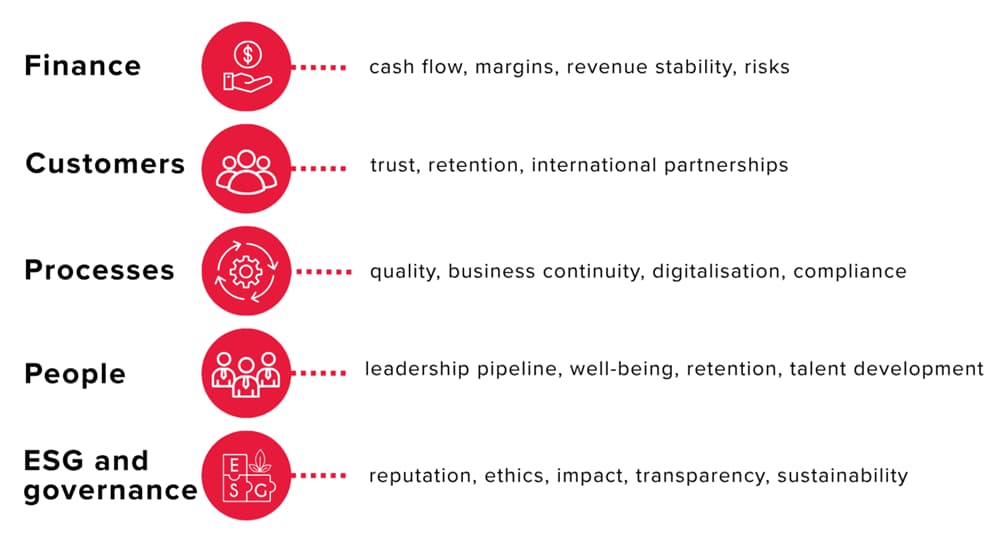
It is particularly important that the ESG-BSC aligns well with Ukraine’s new economic reality, especially in frontline regions. For these regions, ESG is about more than just reporting or meeting investor expectations. It is about survival, trust and recovery.
The social component is paramount: job creation, ensuring worker safety, supporting veterans, integrating internally displaced persons, developing local suppliers and encouraging businesses to participate in community recovery. In terms of governance, it is about transparency in decision-making, anti-corruption practices, and the quality of aid and investment management. Environmental issues include infrastructure restoration, energy efficiency, the sustainability of new production facilities, and reduced dependence on vulnerable resources.
This is precisely why a BSC with an ESG dimension can serve as a common language for dialogue between business, communities, the state, donors, and international investors in frontline regions. OKRs can facilitate the rapid implementation of specific initiatives, such as launching a new service, opening a relocated office, or preparing a grant application. However, the balanced scorecard provides a broader perspective, asking whether this initiative will create long-term sustainability for the company and the region.
International financial institutions, investors, donors and major partners are increasingly evaluating companies based on factors beyond profit. They also consider governance, sustainability, ethics, transparency and impact. For a country undergoing reconstruction and integration into the European space, this is becoming the key to accessing capital and partnerships, not an “optional extra”.
Here, the BSC proves to be far more modern than it is often perceived. At the same time, this does not mean that OKR should be discarded. On the contrary, OKR can be very useful, but not as the primary system for managing a company.
OKRs work perfectly for:
— innovative projects
— digital transformation
— AI (Artificial Intelligence) adoption
— launching new services
— breakthrough strategic initiatives
— cross-functional teams
— short execution cycles
In other words, OKRs are an excellent tool for “must win battles”, when a company needs to focus its resources quickly on a few key changes.
However, OKRs should not replace a comprehensive strategic management system.
Therefore, the most mature approach for Ukrainian companies currently looks like this:
- The Balanced Scorecard / ESG Scorecard — as the foundation of strategic management.
- KPIs (Key Performance Indicators) — as a system of operational discipline.
OKRs as a tool for breakthrough initiatives and innovation
This model enables us to combine resilience and speed, control and adaptability, and governance and innovation. Perhaps the main lesson for Ukrainian businesses today is that, in times of high uncertainty, it is not only the fastest companies that succeed. The most successful companies are those that can be flexible, resilient and systematic simultaneously.
For frontline regions, this issue runs even deeper. There, strategy is not just about business growth. It is also about sustaining economic life, supporting people, rebuilding communities, and laying the foundations for future reconstruction.
This is precisely why Ukrainian companies are now viewing the system of balanced scorecard based on ESG principles not as “old-school”, but as a very modern system of responsible management.