

Business supports change — not the absence of control
BDO in Ukraine has presented the findings of a business survey on interaction with the tax authorities and a practical model for improving tax control in Ukraine.
The survey covered 44 companies representing 15 sectors of the economy and included businesses affiliated with different business associations and industry organisations. We thank all participating companies for sharing their practical experience, which helped identify the most pressing issues and priorities for change.
The key conclusion is clear: business is not calling for weaker tax control, but for higher-quality, more predictable and risk-proportionate control.
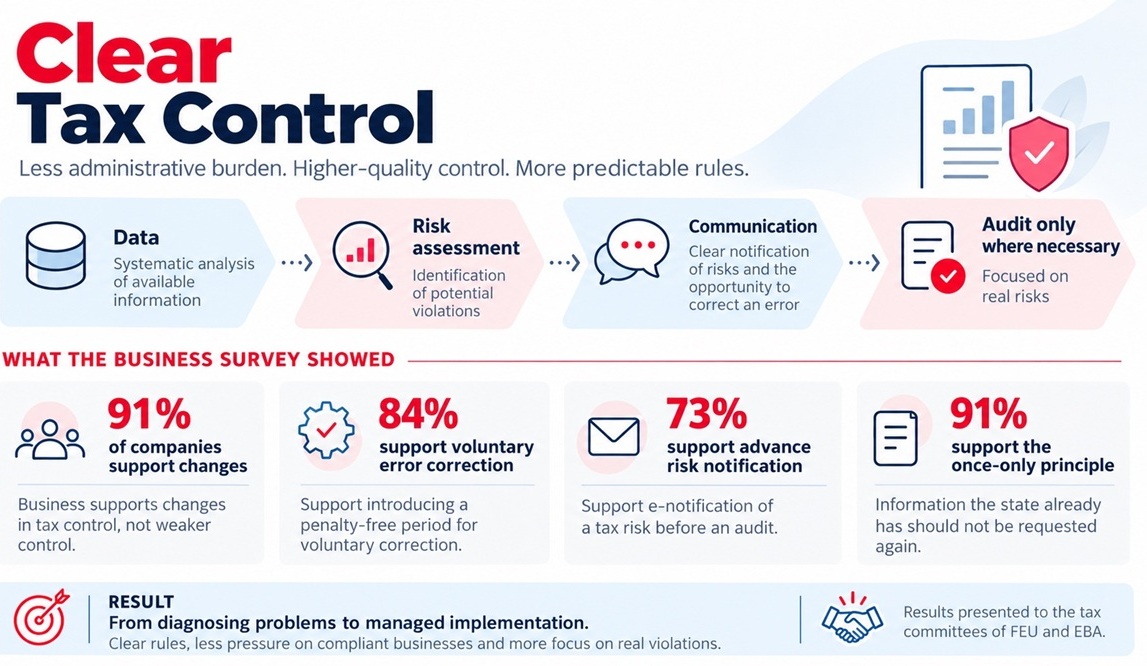
91% of respondents support substantial changes to the tax control system. Among the most significant concerns identified by companies are the fiscal focus of tax audits, repeated requests for documents, insufficient early communication about tax risks and limited opportunities for rapid procedural protection.
Companies also identified practical solutions. 84% included the opportunity to correct an error voluntarily before an audit among their top five priorities, 73% prioritised advance electronic notification of a specific tax risk, while 91% support the once-only principle: information already available to the state should not be requested again without a justified need.
An audit as the last rather than the first response
The proposed model follows a straightforward sequence:
This is not about weakening control over genuine violations. More targeted, risk-based administration can help the tax authorities focus resources on significant risks and deliberate non-compliance while reducing unnecessary administrative costs for compliant businesses.
The model also proposes greater reuse of documents already submitted, clearer audit scope, reasoned consideration of taxpayers’ explanations and broader performance indicators. The effectiveness of tax control should be assessed not only by additional assessments, but also by actual budget revenues, the quality of decisions and the duration of procedures.
In developing the proposals, approaches used in EU Member States including Lithuania, Latvia, Estonia, Poland, Romania, Portugal, the Netherlands, Austria and Italy were reviewed. The objective is not to replicate another country’s system, but to adapt the principles of risk-based administration, digitalisation, preventive communication and procedural predictability to the Ukrainian context.
Dialogue with the business community
The survey findings and proposed model were presented to the Tax Committee of the Federation of Employers of Ukraine, discussed within the Tax Committee and Ukraine Recovery Committee of the European Business Association, and shared at other professional business-community platforms.On behalf of BDO in Ukraine, the findings and proposals were presented by Vira Savchenko, CEO of BDO in Ukraine, and Andrii Borenkov, Head of Advisory at BDO in Ukraine.
Engagement with business associations and the broader business community is an important part of further refining the proposals. Further professional dialogue is expected to focus on the practical application of selected elements of the model and opportunities to assess them against measurable indicators.
For business, the expected benefits are fewer unnecessary procedures and greater predictability. For the state, they are better-quality control and more resources focused on genuine violations. For the tax system overall, they are clearer and more transparent rules of interaction.
Presentation of the survey findings and proposed model (available in Ukrainian):
Please use the contact form to submit any additional questions or suggestions.