BDO in Ukraine at Norwegian-Ukrainian Business Forum 2026: Investment and Priorities for Ukraine’s Reconstruction
The Norwegian-Ukrainian Business Forum 2026 took place in Lviv — one of the largest Ukrainian-Norwegian business events in recent years. The forum brought together over 250 representatives from Ukrainian and Norwegian business, central and local government bodies, investors, industry associations and international organisations.
Discussions centred on: attracting private investment for Ukraine’s reconstruction, developing economic partnership between Ukraine and Norway, managing risks for international investors, and the practical involvement of the business community in implementing future infrastructure and reconstruction projects.
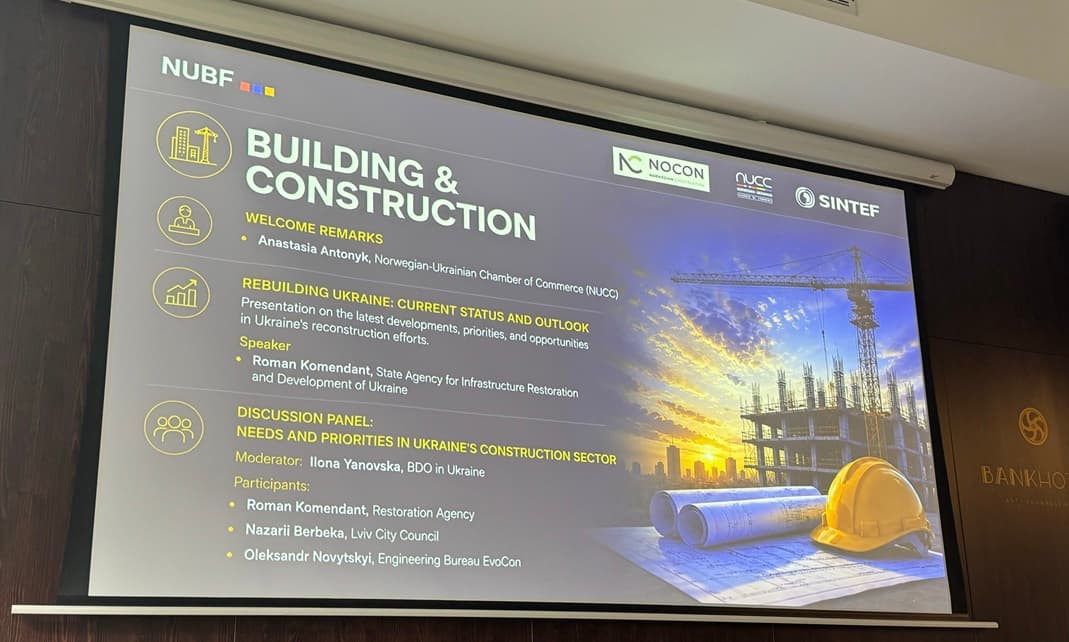
As part of the forum, Ilona Yanovska, the analyst at BDO in Ukraine, moderated a panel discussion entitled “Needs and Priorities in Ukraine’s Construction Sector”, focusing on the needs and priorities of Ukraine’s construction sector. Participants discussed the extent of the damage, funding for reconstruction, the construction sector’s project and human resources capacity, the use of BIM technologies, the “Build Back Better” principle and modern approaches to the development of Ukrainian cities and communities.
The Norwegian-Ukrainian Business Forum 2026 was organised by the Norwegian-Ukrainian Chamber of Commerce, Innovation Norway, Lviv City Council, IRON Cluster, the Ministry of Economy, Environment and Agriculture of Ukraine, and the Embassy of Norway in Ukraine.
The forum was opened by Yegor Perelygin, Deputy Minister at the Ministry of Economy, Environment and Agriculture of Ukraine; Vegard Grøslie Wennesland, State Secretary at the Norwegian Ministry of Trade, Industry and Fisheries; and Andriy Sadovyi, Mayor of Lviv.
In their speeches, they emphasised the need for more active involvement of private capital in Ukraine’s recovery, the development of effective investment risk management tools, the strengthening of the Ukrainian-Norwegian economic partnership, and the practical role of business in the preparation and implementation of reconstruction projects.
Norway Desk in Lviv: support for Norwegian companies in Ukraine
Discussions on investment cooperation were accompanied by concrete institutional decisions. During the forum, a memorandum was signed on the establishment of the Norway Desk in Lviv — a service platform designed to support Norwegian companies planning to operate, develop their business or invest in Ukraine.The initiative aims to make it easier for Norwegian businesses to find local partners, access professional expertise and navigate the Ukrainian regulatory environment. The establishment of the Norway Desk is also intended to promote the development of bilateral economic cooperation and the transition from initial interest to the development of specific investment and commercial projects.
Alongside general issues of investment policy, forum participants moved on to discuss sector-specific opportunities. The programme covered sectors that currently hold significant potential for Ukrainian-Norwegian economic cooperation, in particular defence and dual-use technologies, energy, medical technologies, the agri-industrial sector, and reconstruction, renovation and construction.
Industrial cooperation in the Defence & Dual-use sector
The Defence & Dual-use track served as a platform for discussing industrial partnerships between Ukrainian and Norwegian companies. Participants in this thematic session included Vyriy, DK NEJET, NORDA Dynamics, Maritime Robotics, Oko Camera, Pai Defence and Protectoria.Unlike traditional discussions, which tend to focus primarily on the supply of defence products, participants discussed opportunities for long-term industrial cooperation, joint technology development and the integration of Ukrainian companies into European production and technology chains.
During the discussion, it was emphasised that Ukrainian technology companies have significant experience in rapidly developing, testing and adapting solutions in challenging conditions. Norwegian partners can also help with raising capital, developing engineering expertise, scaling up production and enabling Ukrainian companies to enter international markets.
Needs and priorities of Ukraine’s construction sector
The topic of Ukraine’s reconstruction was covered in a separate discussion programme dedicated to the challenges facing the construction industry and the practical implementation of infrastructure projects.As part of this programme, Ilona Yanovska, the analyst at BDO in Ukraine, moderated the panel discussion “Needs and Priorities in Ukraine’s Construction Sector”.
The following participants joined the discussion:
- Roman Komendant, Deputy Head of the State Agency for the Restoration and Development of Ukraine’s Infrastructure, responsible for digital development, digital transformation and digitalisation.
- Nazarii Berbeka, representative of Lviv City Council.
- Oleksandr Novytskyi, Head of Engineering Bureau EvoCon.
The panellists examined the extent of the damage, the need for infrastructure reconstruction, and Ukraine’s capacity to prepare and implement reconstruction projects using its own resources, international funding and the expertise of foreign partners.
During Roman Komendant’s presentation, it was noted that a portfolio of international investment projects worth around 1.5 billion euros is currently being implemented in Ukraine. It covers 15 regions of the country and is being implemented with the support of the World Bank, the European Bank for Reconstruction and Development, the European Investment Bank, the Japan International Cooperation Agency (JICA), the European Union and other international institutions.
One of the key points of the discussion was that, despite the gradual strengthening of Ukraine’s domestic capacity, the implementation of a significant proportion of large-scale reconstruction projects continues to rely on financial, technical and institutional support from international partners.
At the same time, the effectiveness of this support depends not only on the availability of funding, but also on the quality of project preparation, the transparency of procedures, the availability of competent teams, realistic planning and the ability to manage risks at all stages of implementation.
Reconstruction or new construction
Approaches to the preparation and implementation of future reconstruction projects were the subject of a separate discussion. Participants considered the choice between the reconstruction of damaged facilities and new construction, considering the technical condition of the structures, economic viability, the needs of local communities and the long-term development prospects of the areas.The discussion also touched upon the application of the “Build Back Better” principle, according to which reconstruction should not be limited to simply restoring facilities to their previous condition. Future projects must aim to improve the safety, energy efficiency, accessibility, sustainability and functionality of infrastructure.
This approach makes it possible to consider the future needs of communities, demographic changes, new demands on the urban environment and the need to adapt infrastructure to long-term economic and social challenges.
BIM technologies in construction and infrastructure projects
The use of Building Information Modelling (BIM) for the planning, design and implementation of construction and infrastructure projects has become a key topic.The use of BIM makes it possible to integrate architectural, engineering, technical and financial data about a project into a single digital model. This facilitates better coordination between project stakeholders, the timely identification of errors, more accurate planning of timelines and costs, and greater transparency in project delivery.
In the context of Ukraine’s large-scale reconstruction, the digitalisation of construction processes could become a key tool for improving the efficiency of public, private and international funding.
At the same time, the successful implementation of BIM requires not only the appropriate software, but also trained specialists, uniform standards, high-quality source data and proper coordination between clients, designers, construction companies and public authorities.
Rising material costs and labour shortages
The next set of questions focused on the factors determining the construction sector’s capacity to deliver reconstruction projects. Participants discussed the rising cost of building materials, changes in the labour market, the shortage of skilled workers and the need to scale up vocational training and reskilling programmes.According to the findings of a study presented by Nazarii Berbeka, rising material costs have a direct impact on the budgets, timelines and economic viability of construction projects. Given the long duration of such projects, price fluctuations may necessitate a review of cost estimates, funding terms and work schedules.
The labour shortage also remains one of the key constraints to scaling up reconstruction efforts. The construction sector requires not only skilled workers, but also engineers, architects, project managers, and specialists in cost estimation, digital modelling, health and safety, and environmental and social issues.
At the same time, participants emphasised that one of the key tools for overcoming the skills shortage is collaboration between businesses and educational institutions, which involves providing students with practical training, involving them in real-world projects and facilitating their subsequent employment within companies in the sector.
To ensure the sector’s long-term viability, such initiatives should be scaled up and complemented by retraining programmes for veterans, internally displaced persons and other groups who can join the labour market in the reconstruction sector.
From restoration of facilities to territorial development
Alongside issues of funding, staffing and project capacity, participants discussed the long-term implications of decisions being made right now.In particular, Oleksandr Novytskyi drew attention to the issue of territorial revitalisation and contemporary approaches to urbanism. He emphasised the need to plan reconstruction projects considering the future development of cities, changes in the demographic structure, the needs of communities and opportunities for economic growth.
The revitalisation of areas involves not only the physical restoration of damaged infrastructure, but also a rethinking of the functions of urban spaces, the creation of new economic opportunities, the development of public spaces, improvements to the quality of the environment and more efficient use of land.
This approach is particularly important for communities where the war has significantly altered the demographic structure, economic activity and needs in terms of housing, transport, education, healthcare and social services.
How to scale Ukraine’s reconstruction over the next 3-5 Years
To conclude the discussion, panel moderator Ilona Yanovska posed a question to the participants that shifted the conversation from current challenges to a strategic perspective:“How do you envisage the development of Ukraine’s reconstruction process over the next 3–5 years, to ensure its continued scaling up and systematic approach?”
This question served as a logical conclusion to the discussion, which had centred on funding, human resources, project capacity, digitalisation, modern approaches to planning, and the long-term sustainability of the recovery process.
One of the key conclusions was that scaling up the reconstruction effort requires a systematic approach that combines high-quality project preparation, transparent procedures, access to funding, human capital development and coordination between the state, local communities, the business sector and international partners.
Alongside the restoration of damaged facilities, it is important to lay the foundations now for the long-term development of these areas, to improve the quality of the urban environment and to create infrastructure capable of meeting the future needs of local communities.
The Ukrainian-Norwegian partnership turns plans into projects
The Norwegian-Ukrainian Business Forum 2026 demonstrated the growing interest of international business in participating in Ukraine’s recovery and the readiness of Ukrainian and Norwegian partners to move from discussing general opportunities to developing specific cooperation projects.At the same time, international interest should be underpinned by well-prepared projects, transparent business models, a clear risk framework, realistic financial projections and capable teams that can ensure practical implementation.
For BDO in Ukraine, participation in the forum provided an opportunity to engage in professional discussions on the challenges and priorities facing the construction sector, as well as in a broader dialogue on mechanisms for attracting investment and implementing Ukraine’s reconstruction projects.
The outcomes of these discussions form the basis for better preparation of investment and infrastructure projects, attracting international funding, risk management and coordination between government institutions, businesses, communities and international partners.
Planning an investment or reconstruction project in Ukraine?
BDO in Ukraine’s specialists help Ukrainian and international companies assess opportunities and risks, enter the Ukrainian market, prepare investment and infrastructure projects, develop financial models and enhance projects’ readiness for securing funding and practical implementation.Our team can provide support in the following areas:
- advice on entering the Ukrainian market — analysis of the market, regulatory environment, competitive landscape, business models and practical steps for launching operations
- investment consultancy and corporate finance — financial modelling, assessment of investment attractiveness, structuring of financing and preparation of materials for investors
- due diligence and risk assessment — financial, tax, legal, commercial and operational due diligence of projects, assets and potential partners
- business consultancy and project management — developing implementation models, assessing organisational capacity, and establishing processes, control systems and risk management frameworks
- ESG, sustainable development and occupational health and safety — integrating environmental, social, governance and safety requirements into construction, infrastructure development and reconstruction projects.
Please complete the form below, and BDO in Ukraine specialists will contact you to discuss your project, assess your needs and identify practical next steps.