934 Tenders in Eight Months: How Donor Funding Is Evolving in Ukraine
934 Tenders in Eight Months: How Donor Funding Is Evolving in Ukraine
In the first eight months of 2026, 934 tenders from international donors were announced in Ukraine, surpassing the total recorded in any full year between 2021 and 2025.
At the same time, Ukraine’s grant market is evolving in a different direction. While the number of grant calls is declining, programmes are becoming larger and more complex. As funding volumes grow, so do donors’ expectations regarding organisations’ ability to manage and report on the funds they receive.
These trends were the focus of BDO Ukraine’s webinar, “Donor Funding in Ukraine: How to Access Funding and Manage Projects Effectively”, held on 24 September 2026.
BDO experts explored the full donor funding lifecycle: where to find grants and tenders, what donors evaluate in grant applications, the most common challenges encountered during project implementation and audits, and how digital solutions can help organisations manage donor-funded projects more effectively.
How has the donor funding market in Ukraine changed in 2026?
Opening the analytical section of the webinar, Andrii Borenkov, Partner and Head of Advisory at BDO in Ukraine, highlighted a key market paradox: despite the reduction of some traditional funding sources, the overall volume of donor opportunities has increased significantly.During the first eight months of 2026, 934 tenders were announced with a disclosed budget of approximately €908.6 million. By comparison, 873 tenders were recorded in 2024 and 714 in 2025.
Notably, the disclosed tender budget for the first eight months of 2026 exceeds the combined disclosed budgets of the previous five years. However, it is important to note that budgets were disclosed for only around 11% of the tenders analysed, and a significant share of this year’s increase was driven by several large-scale programmes financed by international financial institutions.
Activity peaked during the summer months. In June 2026, disclosed tender budgets totalled approximately €615 million, and in July at €222 million.
International financial institutions continue to dominate the funding landscape, including: the World Bank, the EIB, the CEB, the EBRD, the IFC and other international institutions.
The structure of available opportunities is equally revealing. By number, 87% of tenders are for consultancy services. As a result, success in international donor procurement depends not only on financial capacity but, above all, on a team with proven expertise and a strong track record in delivering similar projects.
What is happening in the grant market in Ukraine?
The grant sector is following a different trajectory. After reaching record levels with 515 calls for proposals in 2023 and 539 in 2024, the number declined to 477 in 2025. Despite this reduction, the total disclosed grant budget increased to €292 million.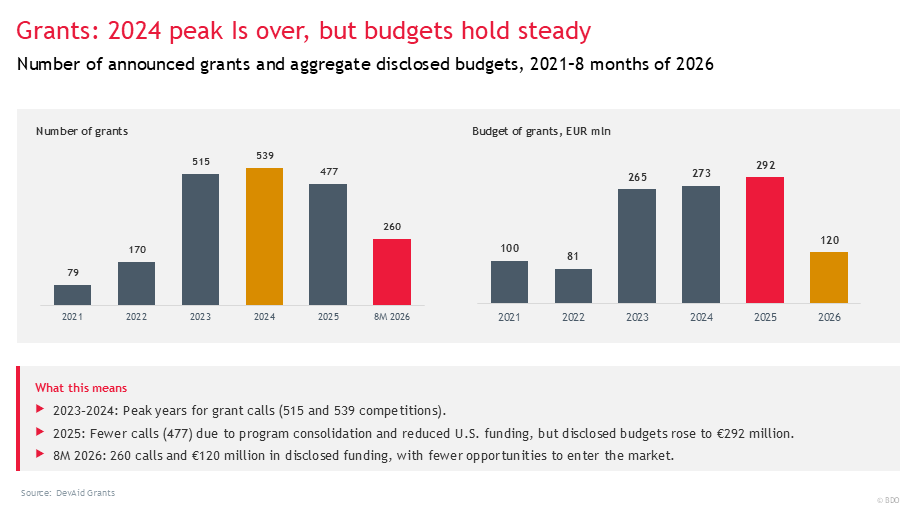
In the first eight months of 2026, 260 grant competitions were announced, with an aggregate disclosed budget of approximately €120 million. In other words, there are fewer opportunities to apply, but funding is increasingly concentrated in larger, higher-value programmes.
Another significant shift concerns the geography of funding. Following a substantial reduction in USAID activity, financial support is increasingly being provided through the European Commission, international financial institutions and Nordic donors.
For Ukrainian organisations and businesses, this means reassessing existing fundraising strategies and closely monitoring the changing structure of the donor market.
Key takeaway: donor funding has not diminished. Instead, its sources, formats, and requirements have evolved.
What do donors look for in grant applications today?
While the first part of the webinar focused on where funding opportunities exist, the next section addressed a crucial question: what does it take to secure funding?Ilona Yanovska, Analyst at BDO in Ukraine, presented findings from an analysis of grant programmes conducted during 2025-2026. One of the key conclusions was that donor assessment begins long before the project idea itself is evaluated.
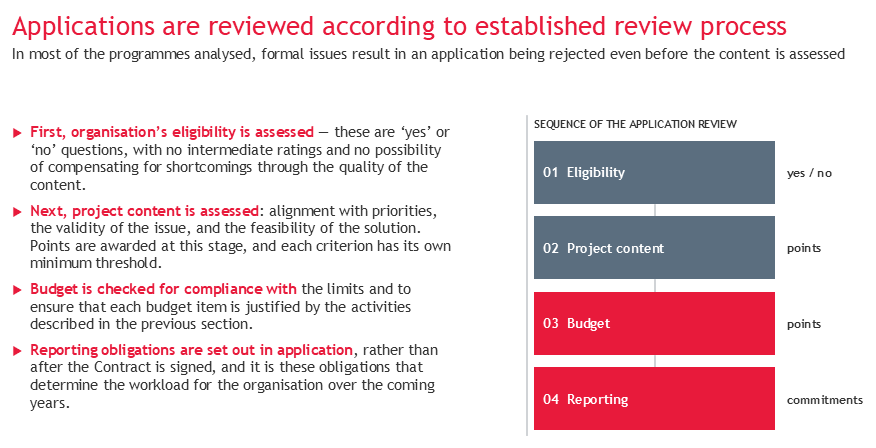
Donors first assess organisational eligibility, including legal status, non-profit status, operational history, geographic scope, and experience in delivering and reporting on previous projects. At this stage, there is little room for flexibility: failure to satisfy a single mandatory requirement can disqualify an application, regardless of the strength of the proposed project. Only after eligibility is confirmed do donors evaluate the project concept, budget and future reporting obligations.
The analysis also showed that donors fund measurable change, not simply a list of activities. A broad project scope, often seen by applicants as a strength, can sometimes be interpreted as a lack of clear outcomes.
Seven of the eight most common weaknesses identified in unsuccessful applications relate to project logic and design, including alignment with programme priorities, risk management, partnerships, scalability, and the sustainability of outcomes after funding ends.
Internal consistency is equally important. Project objectives, activities, budgets, and indicators must function as a coherent system. Every activity should be budgeted, every objective should have measurable indicators, and every budget item should be clearly justified.
The scoring structure of many grant programmes reinforces this principle. In a typical 100-point evaluation model, approximately half the available points may be allocated to organisational capacity and project planning, while the quality and feasibility of the project concept itself may account for only around 30%.
As donor programmes grow larger and more sophisticated, demonstrating strong organisational capacity is becoming increasingly important.
Auditing grant projects: where do mistakes most commonly occur?
Securing funding is only the beginning. Equally important is implementing the project correctly and ensuring compliance with donor requirements.Nataliya Liakh, Deputy Head of the Audit Department at BDO in Ukraine, and Svitlana Danylenko, Auditor at BDO in Ukraine, shared practical insights based on their experience auditing donor-funded projects.
Unlike a traditional financial audit, a grant audit does not simply verify that funds were spent. Donors also require evidence that expenditures align with project objectives, approved budgets, implementation timelines, procurement requirements, and the terms of the grant agreement.
The most common issues include:
- breaches of procurement procedures
- incomplete documentation of supplier selection process
- incorrect application of exchange rate
- budget overspending without prior approval
- insufficient evidence of project activities performed
- expenditure incurred outside the project eligibility period
- errors in accounting for personnel costs.
One of the most important lessons from audit practice is that preparation for an audit of grant project should begin on the first day of project implementation, not at the end of the project cycle.
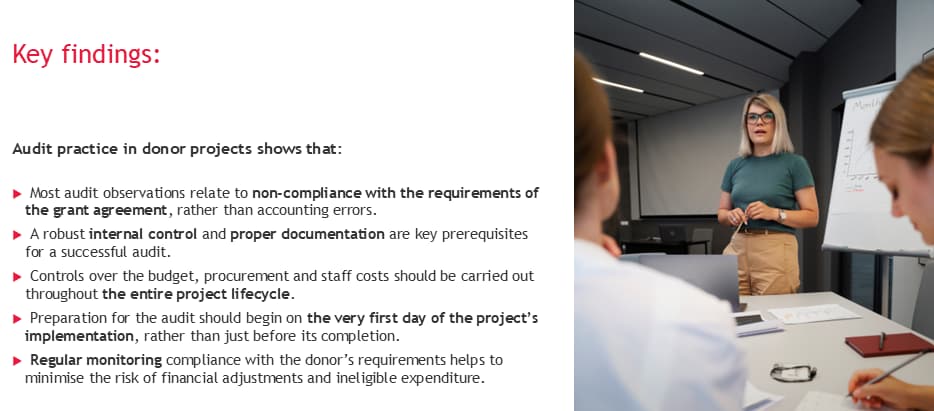
Maintaining dedicated procurement files, comprehensive project records, regular budget monitoring, accurate timesheets, and effective internal controls can significantly reduce the risk of ineligible expenditures and financial corrections.
In practice, the organisational capacity evaluated during the application stage must be demonstrated consistently throughout project implementation.
How can digitalisation and AI improve donor project management?
The final section of the webinar focused on cloud technologies, automation, and artificial intelligence.Andrii Paios, IT Director at BDO in Ukraine, highlighted a challenge faced by many organisations: project teams often store documents across personal accounts, communicate through multiple messaging platforms, and work from numerous local file versions.
This approach creates more than operational inefficiencies. It increases the risk of data loss, weakens version control, complicates access management, creates dependency on individual employees, and exposes sensitive information belonging to donors, partners, and beneficiaries.
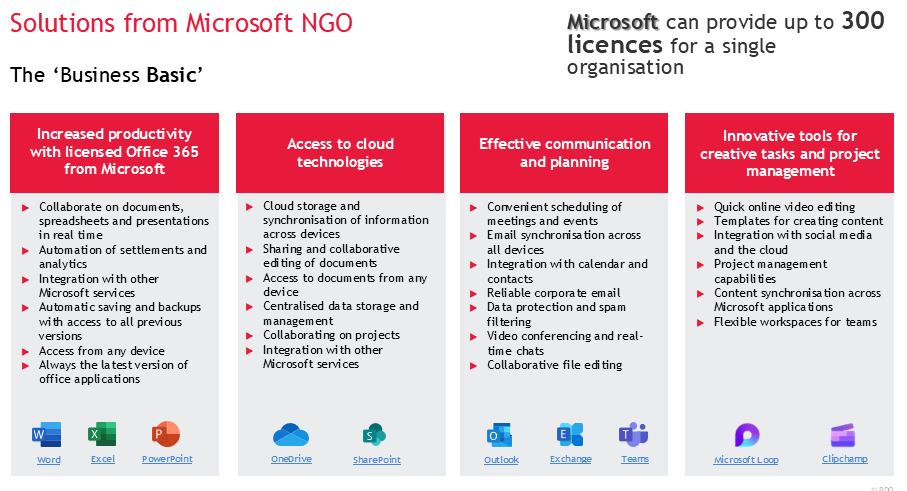
A centralised cloud environment provides the foundation for process automation, project management optimisation, and AI-powered tools.
Microsoft solutions for non-profit organisations offer capabilities for collaborative document management, internal communications, file storage, project planning, and workflow automation.
A practical example was presented by Diana Glushchenko, Business Analyst at BDO in Ukraine, using the case study of the Kyiv-Mohyla Academy Alumni Association.
Automation made it possible to consolidate contact registration, membership fee accounting, payments, notifications and participants’ access to the internal portal. As a result, contact information, payments, and applications are managed within a single system, reducing administrative workload and improving operational efficiency.
Yehor Terekhov, Business Applications Developer at BDO in Ukraine, demonstrated how this approach can be further developed using Microsoft Dynamics 365, workflow automation, and Copilot. A unified platform can consolidate information on programmes, donors, beneficiaries, contracts, and communications, while AI tools help teams work more efficiently with this organised corporate information. This is where all four themes of the webinar converge. Identifying funding opportunities, preparing high-quality applications, managing projects effectively, and embracing digital transformation are no longer separate activities. Together, they form a single process.
The full webinar recording is available via the link.
From grant search to a donor funding management system
Ukraine’s donor funding market remains substantial, but it is becoming increasingly structured and demanding.The organisations most likely to succeed are those that diversify funding sources, monitor donor opportunities proactively, demonstrate strong organisational capacity, prepare for audits from the outset, and establish robust data management systems.
BDO in Ukraine supports organisations throughout the entire donor funding journey, from monitoring grants and tenders, preparing applications to project management, grant audits, internal controls enhancement, digital transformation, process automation and the implementation of Microsoft and AI solutions.
If your organisation is seeking donor funding or already managing projects financed by international partners, the team of BDO in Ukraine can help you assess opportunities, meet donor requirements, and establish the processes needed not only to secure funding but also to manage it effectively.