From Interest to Practical Steps: BDO in Ukraine Presented Business Guide for Dutch Companies
From Interest to Practical Steps: BDO in Ukraine Presented Business Guide for Dutch Companies
Last week, a presentation of the new business guide, “Gateway Ukraine: Business Opportunities for Dutch Companies”, took place. The event focused on practical opportunities for Dutch companies to enter the Ukrainian market and participate in Ukraine’s recovery.
The event was organised by the Netherlands Enterprise Agency RVO, the Embassy of the Kingdom of the Netherlands in Ukraine, and BDO in Ukraine. Nearly 100 registrations for the webinar reflected strong interest among Dutch businesses in exports, partnerships, investments and recovery projects in Ukraine.
During the webinar, the BDO in Ukraine team presented the practical guide “Gateway Ukraine: Business Opportunities for Dutch Companies” developed at the request of RVO and the Embassy of the Kingdom of the Netherlands in Ukraine. The guide helps companies move from an initial interest in the Ukrainian market to defining a specific operating model, potential buyers and partners, sources of financing, procurement channels, and risk management approaches.
Practical route for entering the Ukrainian market
Opening the webinar, Alla Piatakova, Senior Business Development Adviser at the Embassy of the Kingdom of the Netherlands in Ukraine, noted that many foreign companies face similar questions: how Ukraine’s business environment works, where to find partners and which financial instruments are available for project implementation.RVO representative Reinoud Nuijten emphasised that Ukraine is not only a country in need of international support, but also a market offering real opportunities for long-term cooperation, partnerships, and investment. At the same time, entering the Ukrainian market requires a structured approach that considers war-related risks, sources of financing, procurement procedures and the requirements of donors and international financial institutions.
The main idea of the webinar was to start not with studying the entire market or a particular sector, but with identifying a specific commercial route for the company.
To do this, a business needs to answer four key issues:
- What problem and need does the proposed product or service address?
- Who is the buyer, and who provides the funding of the project?
- Which procurement procedure will be used?
- Who will be responsible for implementation, maintenance, and ongoing operation of the solution?
If a company can clearly define these components, it gains a foundation for a realistic strategy for entering the Ukrainian market.
Exports, partnerships, tenders or investment
Vira Savchenko, CEO of BDO in Ukraine, presented the structure of the business guide and explained how companies can use it depending on their objectives.The guide provides separate practical routes for:
- exporters and suppliers of goods and services
- companies looking for a Ukrainian partner or distributor
- participants in public, donor-funded, and international procurement
- investors seeking to establish joint ventures
- contractors, integrators, and consortium members
- companies considering public-private partnerships.
“The guide is not merely a market overview, but a tool for finding your own route. A company does not necessarily need to read the guide cover to cover. It should first identify the activities it intends to pursue in Ukraine and then refer to the relevant sections, sectors and practical annexes,” said Vira Savchenko.
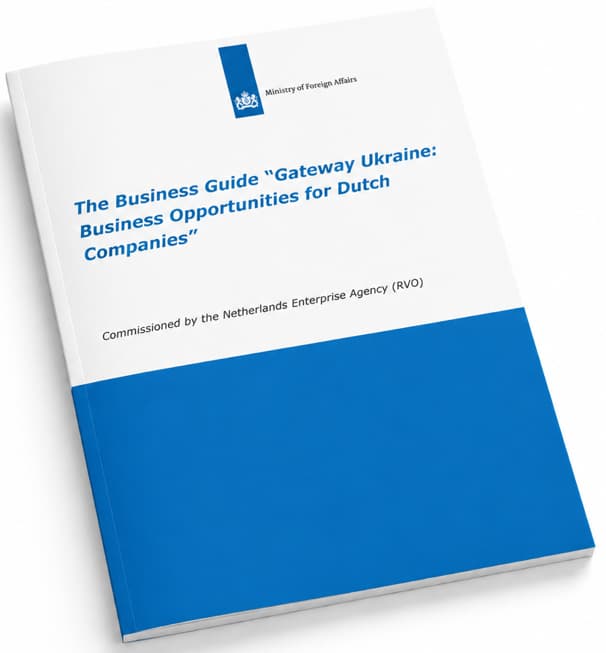
Download the guide.
Five priority sectors for Dutch businesses
During the webinar, particular attention was given to five sectors in which the experience and technologies of Dutch companies may be particularly relevant:
- sustainable energy, energy resilience, energy storage, and biomethane
- the agri-food sector, storage, irrigation, and processing
- water supply, water treatment, monitoring, and loss reduction
- circular construction, modular solutions, and biomaterials
- healthcare, rehabilitation, medical technologies, and modular infrastructure.
The speakers emphasised that the sector itself does not determine the operating model. For example, a water technology company may operate as a direct exporter, a supplier within an international project, a consortium member, a contractor for a municipal project or an investor.
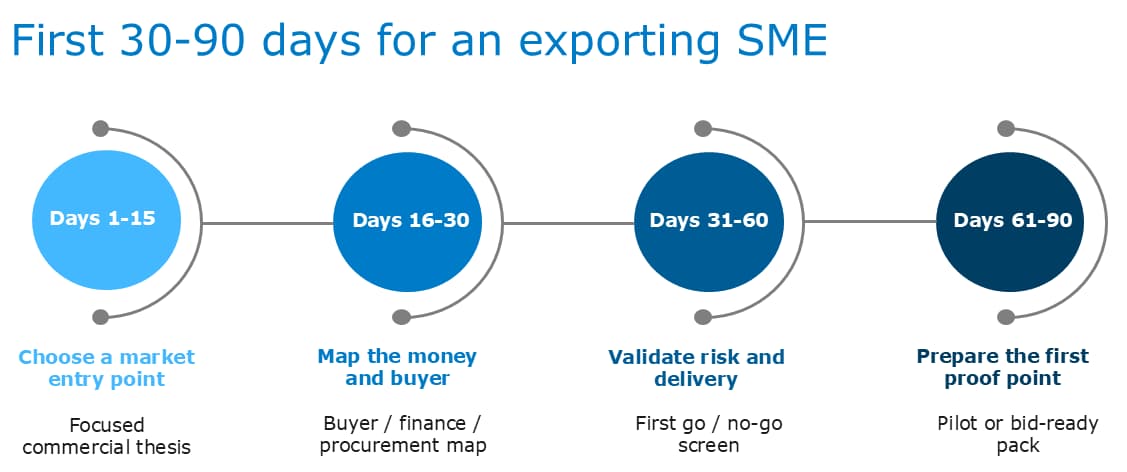
First 90 days for an exporter
Dmytro Chubin, Investment Analyst at BDO in Ukraine, presented a sequence of actions for a small or medium-sized enterprise planning to implement its first project in Ukraine without immediately establishing a local legal entity.The recommended route includes:
- Identifying one specific product use case, region, and customer problem.
- Developing a map of buyers, financing sources, and procurement procedures.
- Integrating payment protection mechanisms, insurance, warranty support, and after-sales service into the commercial proposal.
- Preparing a pilot project, proof of concept, or a complete package for participation in procurement.
The first result does not necessarily have to be a signed contract, but rather a clear understanding of the market: one priority scenario, a list of potential buyers, an initial risk assessment and a realistic entry route.
Where to track recovery projects and upcoming procurements
The webinar also covered the practical use of the DREAM and Prozorro systems.DREAM helps track projects that are at the planning or preparation stage, including their location, status, initiator, and potential sources of financing. Prozorro and the procurement platforms of international financial institutions display procedures that have already been announced, tender documentation, participation criteria, deadlines, and bidder requirements.
Companies were advised to monitor the following simultaneously:
- DREAM and the Single Project Pipeline
- Prozorro
- procurement pages of donors, international financial institutions, and borrowers.
Waiting for the official announcement of a tender may be too late, as partners, technical specifications, the implementation model, and risk allocation may already have been defined by that time.
For systematic participation in procurement, companies should create an updatable document database in advance. It should contain corporate information, evidence of experience, documents confirming the origin and compliance of products, information on ultimate beneficial owners, sanctions checks, translations, signatory authorisations and materials confirming financial and technical capacity.
Investment and local presence
Andrii Borenkov, Head of Advisory at BDO in Ukraine, discussed a phased approach to investment, the establishment of a joint venture or the development of a local presence.Before opening a company or investing significant capital, an investor should:
- confirm actual demand and identify a specific product use case
- conduct market research and assess a potential partner
- define an operating model — distributor, representative office, Ukrainian company, joint venture, or consortium
- assess possible financing and insurance sources
- choose the minimum necessary form of legal presence for the first 12–24 months.
“A legal entity should not be opened automatically. The form of local presence should correspond to the actual project pipeline, operational needs and the company’s readiness to scale,” emphasised Andrii Borenkov.
Financing and risks as part of commercial proposal
One of the key conclusions of the webinar was that, for the Ukrainian market, financing, insurance, and risk management form part of the product itself.Even a strong technical proposal may lose to a competitor if it does not include a clear financing model, payment protection, insurance coverage, and a contract implementation structure.
Companies should analyse not only the Ukrainian buyer, but also the full project structure:
- the international donor or financial institution
- available grants, loans, guarantees, equity capital, and war-risk insurance
- the Ukrainian institution, municipality, state-owned company or bank implementing the project
- the procurement channel and delivery model
- the role of the Dutch company as a supplier, investor, technology partner, adviser or consortium member.
How BDO in Ukraine can support foreign companies
Entering the Ukrainian market in practice almost always begins with specific questions: where to find a reliable partner, how to verify real demand, which projects are worth participating in, how procurement works and which risks should be considered before starting.The BDO in Ukraine team helps foreign companies understand these issues and develop a realistic route for operating in Ukraine. Depending on the needs of the business, this may include market research, the identification and assessment of potential partners, analysis of recovery projects and tender opportunities, and the preparation of a financial model or investment proposal.
We also advise on the most appropriate form of market presence in Ukraine, the structuring of partnerships or investments, tax and legal matters, accounting support, audit and risk management.
Do you have questions about operating in Ukraine, finding partners, participating in recovery projects, or developing a local presence? Complete the form below, and BDO in Ukraine specialists will contact you to discuss your request.